
A couple of weeks ago, I put Chestnut Farms Single Barrel into a blind tasting to answer a fairly simple question: Is this $150 bottle actually worth $150?
It didn’t exactly run away from the competition.
But that first tasting raised another question. Chestnut Farms Single Barrel is 125 proof, so perhaps it deserved a different kind of fight. Instead of matching it against bottles that happened to occupy roughly the same flavor neighborhood, what would happen if I put it into a lineup of serious, high-proof whiskeys — bottles with some horsepower, some reputation and, in several cases, substantial price tags of their own?
So that’s what I did.
 The Bottles
- Booker’s 25-04 “The Phantom Pipes” — 126 proof, $115
- Chestnut Farms Single Barrel — 125 proof, $150
- Company Tennessee Whiskey Pecan Finished — 121 proof, $110
- Old Glory Tennessee Whiskey “Women’s History Month” — 124 proof, $80
- Stagg 25D — 129 proof, $129
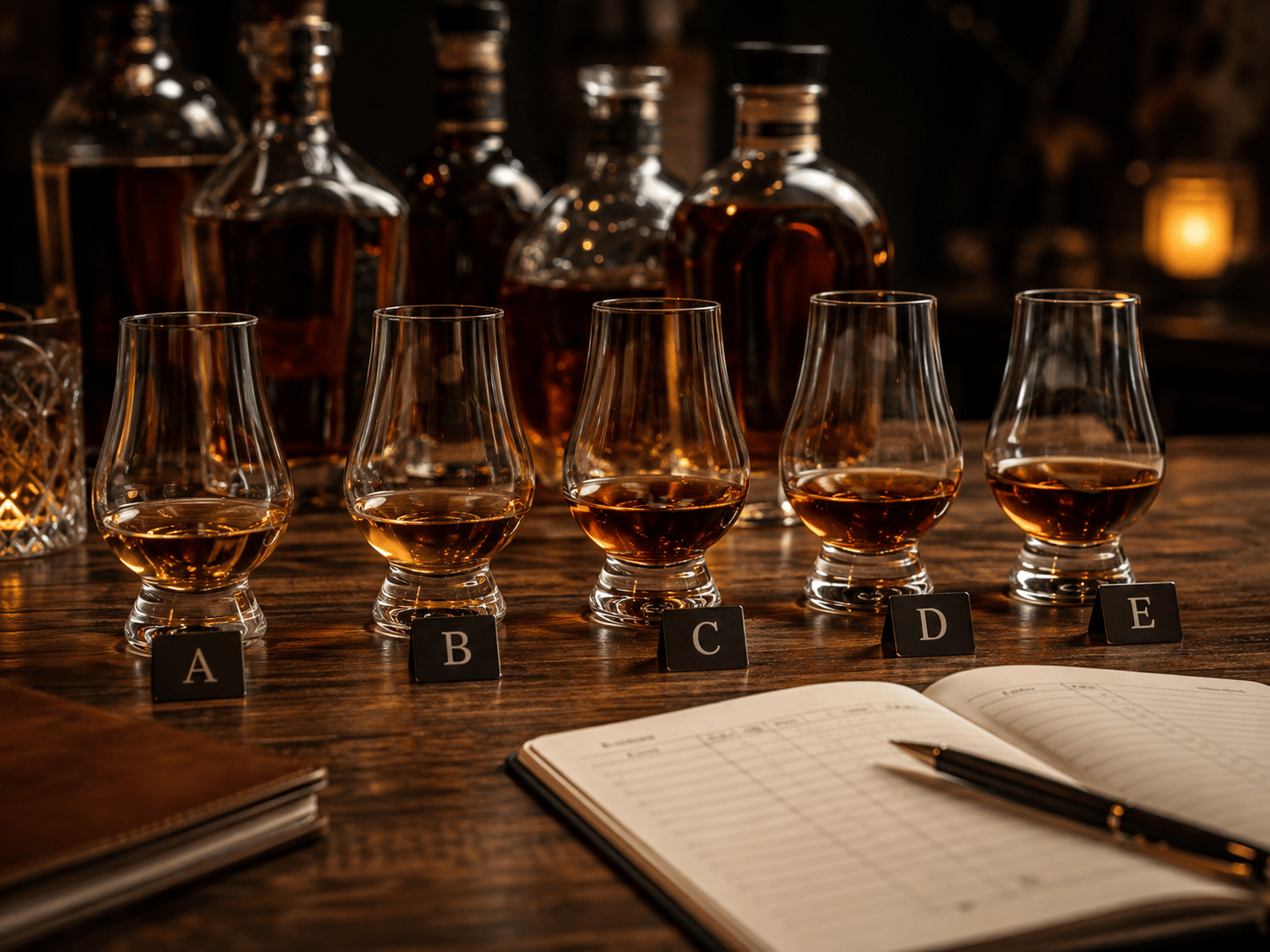
As usual, the samples were poured into identical bottles, mixed up and labeled A through E. I knew what five whiskeys were in the field. I didn’t know which one I was drinking.
And this was a very good field.
Sample A
Rich copper color. The nose leads with sweet red fruit, toasted oak, nutmeg, toffee and a whiff of ethanol. The palate starts with spicy cinnamon, but quickly melds into brown sugar and tart cherries, backed by buttery toffee.
The mouthfeel is rich, and the finish packs a wallop with cinnamon, tart cherries and caramel.
Score: 85.39
This one immediately announced itself as a contender. There was plenty of proof, but enough sweetness and fruit to keep the heat from taking over.
Sample B
Solid copper color. The nose is immediately sweet with caramel apples, toasted oak and light cinnamon. The spice carries into the palate, but the fruit turns red — mixed berries — along with brown sugar and caramel.
The mouthfeel is lightly viscous, and the finish is solid with cinnamon, sweet fruit and toffee.
Score: 83.76
There wasn’t anything wrong with B. In fact, it was very good whiskey. But in this group, “very good” wasn’t necessarily going to be enough.
Sample C
Mid-copper color. The nose leads with a touch of proof, but quickly turns to buttery toffee, light peanuts, nutmeg and light oak.
The palate is super spicy, both from the proof and cinnamon. There’s also sweet red fruit, caramel, toasted nuts, vanilla and mild oak. The mouthfeel is lightly creamy, and the finish balances sweet and tart with brown sugar and cherries.
Score: 84.85
This one brought more aggression than the first two. It tasted like high-proof whiskey and wasn’t particularly interested in hiding it, but there was plenty happening underneath the heat.
Sample D
Mid-copper color. The nose is extremely sweet with ripe tree fruit — apples and pears — followed by butterscotch, warm nuts and toasted oak.
The palate starts with tart cherries and brown sugar, followed by buttery toffee, cinnamon, vanilla and just a hint of oak. The mouthfeel is lightly oily, and the finish is solid with sweet cinnamon, cherries and caramel.
Score: 83.98
Another really good pour. Sweet, fruity and well put together. But again, this was a lineup in which small differences mattered.
Sample E
Solid copper color. The nose is inviting — toasted oak, toffee, nutmeg, brown sugar and mild tree fruit. The palate starts with solid cinnamon and sweet brown sugar, followed by butterscotch, caramel, light oak and cherries.
And then it just keeps getting better.
Buttery toffee, cherries, brown sugar, cinnamon and nutmeg all work together. The mouthfeel is creamy, and the finish may be the best of the night — buttery, with sweet fruit, brown sugar and cinnamon.
Score: 85.50
That was the winner.
Barely.
Only 0.11 points separated E from A, with C sitting less than a point behind them. Even the last-place whiskey was only 1.74 points behind the winner.
There wasn’t a bad bottle here.
But there was still a reveal.
The Reveal
A — Old Glory Tennessee Whiskey “Women’s History Month”
That was a surprise. At $80, the least expensive bottle at regular price came within eleven hundredths of a point of winning the entire tasting.
B — Chestnut Farms Single Barrel
Uh-oh.
The $150 bottle had finished fifth.
C — Booker’s 25-04 “The Phantom Pipes”
That made sense once I knew what it was. The peanut note should probably have tipped me off, and the combination of proof, spice and nuttiness fit the Booker’s profile awfully well.
D — Stagg 25D
Another surprise. Stagg carries enough reputation — and generates enough hunting — that seeing it finish fourth feels almost wrong. But that’s why I do these blind. The label wasn’t there to tell me how much I was supposed to like it.
E — Company Tennessee Whiskey Pecan Finished
And there was the winner.
The pecan-finished Company whiskey narrowly took the tasting with the richest overall combination of flavor, mouthfeel and finish.
The Finish Line
- Company Tennessee Whiskey Pecan Finished — 85.50
- Old Glory Tennessee Whiskey “Women’s History Month” — 85.39
- Booker’s 25-04 “The Phantom Pipes” — 84.85
- Stagg 25D — 83.98
- Chestnut Farms Single Barrel — 83.76
Now comes the part where the Bourbon Cheapskate gets involved.
And that’s where the standings change.
Company won the tasting, and at $110 it certainly wasn’t wildly overpriced for the quality in the bottle. But Old Glory finished just 0.11 points behind it while costing $30 less. Under my Cheapskate formula, that makes Old Glory the clear winner of this particular fight.
Company comes in right behind it. Booker’s also fares well, particularly because I didn’t pay its usual $115 asking price. I picked mine up for $90, which makes an already strong third-place showing look considerably better.
Then we get to Stagg and Chestnut Farms.
Stagg 25D was good. Very good, actually. An 83.98 isn’t a failure by any reasonable measure. But at $129, finishing fourth in this particular group makes the value proposition a little tougher. Stagg’s reputation and scarcity can make simply finding one feel like winning something. The whiskey in my glass, however, didn’t know it was supposed to be Stagg. It finished fourth.
And that brings us back to Chestnut Farms.
Again.
Chestnut Farms Single Barrel scored an 83.76. That’s good whiskey. I enjoyed drinking it. There is no reason for me to pretend otherwise simply because I’m irritated about what I paid for it.
But that’s precisely the problem.
I paid $150 for good whiskey.
At $150, I don’t want a bottle merely capable of surviving in a lineup with Booker’s, Stagg, Company and Old Glory. I want it threatening to win.
Instead, the most expensive bottle in the tasting finished last. That’s becoming difficult to explain away.
Chestnut Farms Single Barrel is 125 proof and comes from Barton 1792 Distillery, and Total Wine currently lists it at $149.99. None of that makes it bad whiskey. What it does is set an awfully high bar for value.
And blind tasting doesn’t care about the story on the shelf tag. It doesn’t care how allocated something is supposed to be. It doesn’t care how impressive the box looks, what a salesperson told me or what name is stamped on the bottle. There’s just whiskey in the glass.
In this glass, Chestnut Farms was very good. The other four were better. And four of them cost less.
That’s a tough way to justify $150.
Enjoyed this? Subscribe and get future reflections, bourbon notes, and assorted nonsense delivered straight to your inbox.
Copyright © 2026 Doug DeBolt
