
Sometimes the greatest victory is simply taking the field.
 I don’t remember exactly when I first saw We Are Marshall. I’m pretty sure it was on video, and it was probably a rental from Blockbuster. But it’s one of those movies that I reach for from time to time, usually during football season. And with Saturday marking the 56th anniversary of the tragedy that inspired the film, this seems like an especially appropriate time to revisit it.
There are a lot of great football movies, and most of them follow a fairly predictable formula. A team faces adversity, overcomes the odds and wins a championship. We get to celebrate with the players and coaches, and we leave feeling good about what they’ve accomplished. We Are Marshall follows a somewhat different formula. Yes, there’s adversity, and yes, there is a big game at the end. But the victory in this movie isn’t a championship. It’s a single football game, and even that isn’t really the point. The victory is that Marshall was playing football at all.
The Story
On November 14, 1970, a chartered Southern Airways jet carrying members of the Marshall University football team crashed just short of Tri-State Airport near Huntington, West Virginia. All 75 people aboard were killed, including 37 players, coaches, university personnel, boosters and the flight crew. In the span of a few seconds, a university lost most of its football team, and an entire community lost sons, fathers, husbands, friends and neighbors.
Directed by McG, We Are Marshall tells the story of what happened next. University President Donald Dedmon (David Strathairn) faces the difficult decision of whether to continue the football program, while surviving player Nate Ruffin (Anthony Mackie) leads the effort to keep it alive. Eventually, Marshall hires Jack Lengyel (Matthew McConaughey), a coach from the College of Wooster in Ohio who takes on a job that few others would even consider.
With the help of surviving assistant coach Red Dawson (Matthew Fox), Lengyel assembles a team of returning players, freshmen, walk-ons and just about anyone else he can find who is willing to put on a helmet. But before he can teach them how to win football games, he has to help an entire community understand that it’s OK to play football again.
The Performances
 I’ve often thought that Matthew McConaughey is playing some version of Matthew McConaughey in most of his movies. But he’s incredibly good at doing that, and his performance as Jack Lengyel is one of my favorites.
One of the things I especially enjoy about McConaughey in this film is the way he paces his dialogue. In an era when so much movie dialogue seems to be delivered rapid-fire, McConaughey makes you wait on his character. Lengyel takes his time getting to the point, sometimes working his way around it before he finally gets there. And by the time he does, you’re paying attention to every word.
There’s also an almost relentless optimism to Lengyel that sets him apart from many of McConaughey’s other characters. I suspect that much of that came from the real Jack Lengyel. The man had to be an eternal optimist to believe he could rebuild a football program under those circumstances, particularly when so many of the people around him were still struggling to get through each day.
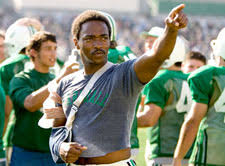 Fox, Mackie and Strathairn all turn in excellent performances, bringing depth and nuance to characters who could easily have become one-dimensional. Fox’s Red Dawson carries a burden that almost consumes him. Mackie’s Nate Ruffin is determined to honor his teammates, but that determination threatens to destroy him. And Strathairn’s Dedmon has the unenviable task of making decisions for a university when there really aren’t any easy or universally acceptable decisions to be made.
The one part of the cast that has never quite worked for me is Ian McShane as Paul Griffen, the father of one of the players killed in the crash. His relationship with Kate Mara’s Annie Cantrell, who was engaged to his son, makes for an unusual subplot. Composite characters are common in fact-based films, and I understand why filmmakers use them. But these two characters and their story seemed a bit more elaborate than necessary, particularly when there were so many compelling real-life stories at the heart of the tragedy. It’s a relatively minor complaint about a movie that gets most of its performances right.
The Weight of Survival
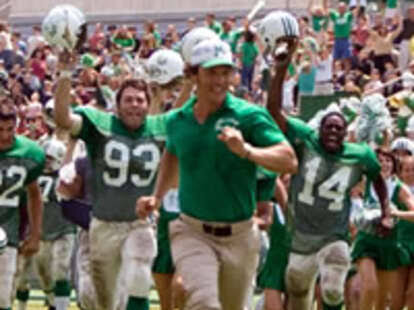 I’ll readily admit that I’m a softie when it comes to emotions in cinema. It doesn’t take a whole lot to get me teary-eyed, and We Are Marshall has more than its share of moments that go straight to that well of tears. But the filmmakers didn’t have to work especially hard to manufacture emotion here. The core story lends itself to it. The vastness of the loss in Huntington is almost unimaginable.
Think for a moment about what it would be like to lose 75 people from your community in a single night. Then consider how many people in Huntington knew not just one of those people, but several of them. There were children who lost parents, parents who lost children and young men who lost virtually every one of their teammates. And when the people of Huntington woke up on the morning of November 15, they had to figure out how to live in a world that was suddenly very different from the one they’d known the day before.
Emotion is the backbone of We Are Marshall, and there are several scenes that get to me every time I watch it. The students gathering outside the university meeting and chanting “We Are Marshall” is one of them. Lengyel’s speech to his players at the cemetery is another. But there are two moments that I think are every bit as powerful, and neither requires a grand speech or a cheering crowd.
The first comes when Lengyel finally confronts Ruffin about his injured shoulder. As he repeatedly slaps Nate on the shoulder, he reminds him that whatever pain he’s feeling at that moment is going to be considerably worse when he gets hit during a football game. But Lengyel isn’t really talking about the shoulder. He understands that Nate has been carrying a much greater burden, and he tells him what Nate desperately needs to hear: What happened to his teammates on that plane wasn’t his responsibility.
Watch Anthony Mackie’s face in that scene. The tears feel real, and so does the relief that gradually spreads across his face. Nate has been trying to carry the weight of an entire football team on his shoulders, figuratively and literally. And here is someone finally giving him permission to put that weight down.
The other moment comes after Marshall’s improbable victory over Xavier. While everyone else is celebrating, we see Red Dawson alone in the locker room. Fox doesn’t need much dialogue to convey what’s happening. Dawson has been carrying his own survivor’s guilt throughout the film, and for the first time, he finally seems to feel the freedom to release some of that guilt and pain.
Those two scenes capture something important about grief. Nate and Red have experienced the same tragedy, but they’ve dealt with it in very different ways. Nate has thrown himself into football, determined to do whatever it takes to honor his fallen teammates. Red has struggled with whether he even belongs on a football field anymore. And both men eventually discover that honoring the dead doesn’t require them to punish themselves for being alive.
A Little Help From Bobby Bowden
 One of my favorite characters in We Are Marshall has relatively little screen time. And as a lifelong Florida Gator, it might surprise some people to learn that the character is Bobby Bowden.
Long before he became a coaching legend at Florida State, Bowden was the head coach at West Virginia University. When Lengyel realizes that his young and inexperienced players aren’t equipped to run the offense he had been using, he decides to install the veer. The problem is that he doesn’t know much about the veer, but he knows someone who does. So he and Dawson head to Morgantown to ask Bowden for help.
In a movie that takes some liberties with the historical record, this is one of the places where the filmmakers didn’t have to embellish the story. Bowden and his coaching staff welcomed the Marshall coaches, gave them access to their playbooks and game films and helped them learn the offense that would give their inexperienced players a fighting chance. The game footage Lengyel and Dawson watch in the movie is actually footage of Bowden’s Mountaineers.
But the moment that really gets me is when we see the backs of the West Virginia players’ helmets. There are little green crosses and the letters MU on them, a tribute to the people who lost their lives in the crash. That wasn’t something the filmmakers dreamed up to make us feel good about Bobby Bowden. He really did that.
Understand that I spent a good part of my adult life rooting against Bobby Bowden. I was steeped in the Bowden-Spurrier rivalry, when Florida and Florida State were playing with national championship implications nearly every year. I celebrated the Sugar Bowl in January 1997, and I’d just as soon forget the Choke at Doak. There was no coach in America I wanted Steve Spurrier to beat more than Bobby Bowden.
But I’ve always had a tremendous amount of respect for Bowden, and what he did for Marshall is a wonderful illustration of why. Here was a football coach who opened his doors, his playbook and his film room to another program that was trying to find its footing after an unimaginable tragedy. He didn’t have to do any of that. And he certainly didn’t have to put a tribute to Marshall on his players’ helmets. But he did, because he understood something that we football fans sometimes lose sight of in the heat of our rivalries.
Some things are bigger than football.
It’s also a reminder of something that runs throughout this movie. We’re not alone in this life, and sometimes we need other people to help us navigate through our grief and pain. The people of Huntington needed each other, but they also needed people outside their community to remind them that others shared in their sorrow and wanted to help. Bobby Bowden did exactly that. And no matter how many times his Seminoles broke my heart on a Saturday afternoon, I’ll always admire him for it.
Getting the Football Right
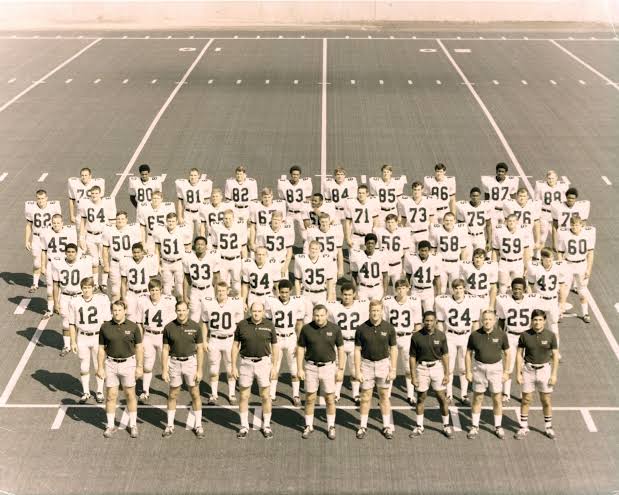
Team photo of the real Marshall Thundering Herd, 1970.
One of my biggest complaints about some otherwise excellent sports movies is that they don’t always get the sports right. Football is a particularly difficult sport to recreate on film because so much happens simultaneously. The blocking, the tackling, the movement of the players and the speed of the game all have to look convincing, and football fans are going to notice when they don’t.
The football action in We Are Marshall is among the best I’ve seen in a movie. There’s one play in which a player comes down on his head, and it’s the kind of moment that makes you wince because it looks so real. You can’t easily fake the way bodies move and collide on a football field, and the filmmakers did an impressive job of capturing that.
I’m particularly impressed with the way the film mirrors the crucial play in Marshall’s final game before the crash with the climactic play against Xavier the following season. The two plays are so well choreographed that you almost feel as though you’re watching the same play unfold, only this time with a different outcome. It’s a wonderful bit of filmmaking, and it gives the ending an additional layer of emotional satisfaction.
And while we’re conditioned to expect a football movie to culminate in a championship, the stakes here are much different. In reality, the Young Thundering Herd defeated Xavier 15-13 on September 25, 1971, and finished the season with a 2-8 record. Jack Lengyel won just nine games in four seasons at Marshall.
By the standards we ordinarily use to judge football coaches, that’s not a particularly impressive résumé. But I would argue that Jack Lengyel accomplished something that many coaches with far more victories and championship trophies could only dream of accomplishing. He helped a community heal.
More Than a Football Movie
There are certainly opportunities to find a faith component in We Are Marshall, but I think its greatest strength is that it’s ultimately a movie about the human condition. Joy, pain, loss, grief and the struggle to find our way forward after something happens that we never could have imagined.
We so often forget that we’re not alone in this thing called life. When something terrible happens, we have a tendency to retreat into ourselves, convinced that no one else can really understand what we’re feeling. And sometimes we’re so busy carrying our own burdens that we fail to realize that the people around us are carrying many of the same burdens. When we share those experiences, we can get through some of the toughest spots in our lives that much more easily. And the same people who help us through our pain are often the people with whom we get to share our greatest joys.
That’s what makes the story of Marshall so compelling. Football didn’t bring back the 75 people who died on November 14, 1970. It didn’t erase the pain of the families who lost loved ones, and it didn’t immediately make life normal again in Huntington. What it did was give people a reason to come together and share the experience of moving forward.
And sometimes it takes a special person to help us remember that we can do that. Jack Lengyel was that person for Marshall. He wasn’t there to tell people to stop grieving, and he wasn’t there to promise that everything would be OK. He was there to help them take the next step, even when they weren’t entirely sure they could. And Bobby Bowden reminded them that they didn’t have to take that step alone.
The Final Cut
We Are Marshall isn’t a perfect movie, but it’s an exceptionally good one. McConaughey is wonderful as Jack Lengyel, the supporting performances are generally excellent, and the football action is as convincing as you’ll find in just about any sports movie. More importantly, the film treats its subject with the respect and emotional weight that it deserves.
It’s a movie that I’ll continue to reach for during football season, and it’s one I’d recommend even to someone who has absolutely no interest in football. Because while the football is important to the story, the lessons of the movie extend well beyond the field.
Most football movies ask us to celebrate a team that overcomes adversity and wins a championship. We Are Marshall asks us to consider what it means to win when the scoreboard is the least important thing in the world.
For Marshall in 1971, winning wasn’t about being the best team in the country. It wasn’t even necessarily about beating Xavier. It was about showing up, putting on the uniform and playing the next game. It was about finding a way to compete again, to celebrate again and to share a little joy with people who had experienced more than their share of pain.
Sometimes, just taking the field is the greatest victory of all.
Enjoyed this? Subscribe and get future reflections, bourbon notes, and assorted nonsense delivered straight to your inbox.
Copyright © 2026 Doug DeBolt.
