
What’s something you’ve forgiven but haven’t forgotten?
View all responses
I’ve got a pretty good memory. Sometimes that’s a blessing, and sometimes it’s a curse. I can remember things people said or did decades ago, often in remarkable detail. Some of those memories bring me joy. Others remind me of experiences I’d just as soon have avoided. But remembering something and holding on to bitterness over it are two very different things.
One of those memories takes me back nearly 40 years, to my time in the United States Air Force. I was young, stubborn, occasionally irresponsible, and not nearly as wise as I thought I was. I also had a commanding officer who, as far as I could tell, didn’t particularly like me. That’s not a great combination when one of you is an Airman First Class and the other is a captain.
To be fair, I gave him reasons to be frustrated with me. My problems started on my very first day at Barksdale Air Force Base in Louisiana. I got lost on the way to the base and arrived late. The captain seemed pleasant enough until he asked for my orders.
“Orders?”
I’d left them at my grandmother’s house in Carthage, Texas, an hour away. That meant another hour back to Carthage and an hour returning to Barksdale. By the time I got back, it was nearly lunchtime. The captain told me to get something to eat and return afterward to finish my in-processing.
Not exactly a stellar first impression.
I don’t think that incident necessarily defined our relationship, but I certainly didn’t help myself afterward. I had a bad habit of arriving at work a minute or two late. In the civilian world, that might not have been a particularly big deal. In the military, however, you’re either on time or you’re late. And I was late.
Our public affairs office was an interesting place, to put it mildly. It sometimes seemed more like a soap opera than a military organization. There were personal dramas, questionable decisions, and activities that probably wouldn’t have survived close scrutiny. Yet somehow, I often felt like the black sheep of the office.
The captain and I never really clicked. He expected his people to toe the line, and I wasn’t always particularly good at doing that. Eventually, my repeated lateness caught up with me, and I received an Article 15, the military’s form of nonjudicial punishment.
Part of my punishment was a stay in Correctional Custody.
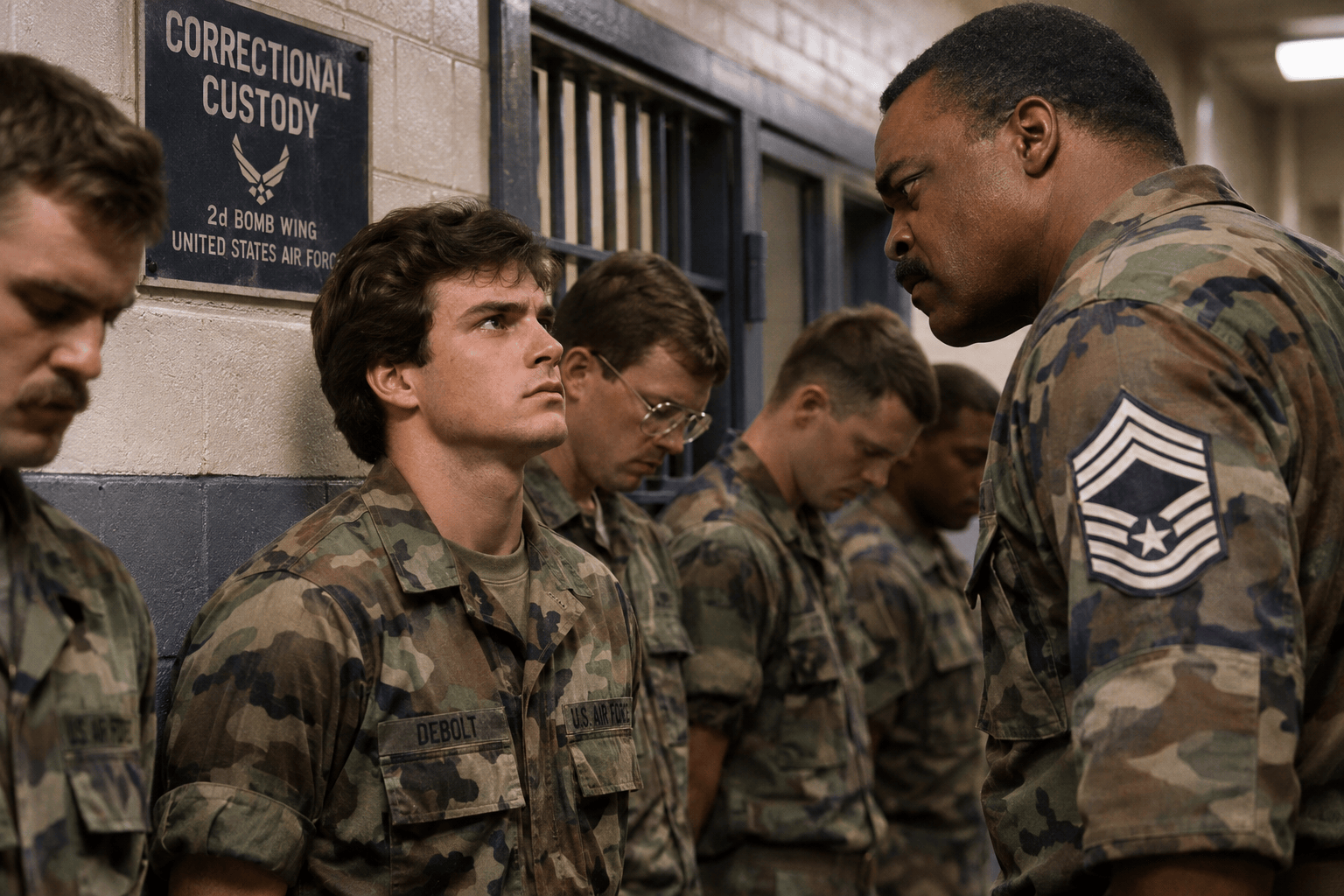 I’d recently written an article about the facility, so there was a certain irony in becoming one of its residents. The place was run by a master sergeant named Milledge, who jokingly called it “Milledgeville.” Anyone familiar with Georgia might appreciate the historical connotation of that nickname.
I found myself surrounded by airmen who had committed considerably more serious offenses than showing up a minute or two late for work. I wasn’t innocent, and I wasn’t entitled to escape punishment. But it was difficult not to notice the differences between my situation and those of the others.
As the days passed, the other airmen in my group were released by their commanders, one after another. Most people didn’t spend more than 20 days there, even though the maximum was 30. I remained until day 24. Only one man from my group stayed longer, and he was there because of serious problems with alcohol.
I couldn’t escape the impression that my captain was making a point.
When I returned to the office, I discovered that I’d lost my position as editor of the base newspaper. The captain reassigned me to edit the base directory. For someone who loved journalism and editing, that was a pretty substantial demotion.
Still, I made an effort to improve. I began showing up on time, or at least very close to it, and reporting for duty in crisply starched uniforms. I worked hard on the directory, using one of the Macintosh computers our civilian printer had provided. This was the late 1980s, when the difference between working on a Mac and a DOS-based PC could be enormous, especially when it came to page layout and design.
Then one afternoon, the captain came to me and announced, loudly and forcefully, that I could no longer use the Macintosh computers. I had to use our Zenith PC, which ran DOS.
I explained that I’d already completed substantial work on the Mac and that none of it could be transferred to the Zenith. Starting over meant throwing away everything I’d done. He didn’t care. I was to stop using the Macs immediately.
Now, here’s where I have to acknowledge my own stubbornness again. I had a deadline that afternoon, and I was determined to meet it. Rather than abandon the project, I stayed with it until I’d finished. That meant I missed the lunch hours on base, so I drove off base to a Subway where I knew one of the employees.
And because I was angry, I took my time.
For years, I remembered being gone for two hours, and I believed that extended absence was what finally cost me my place in the Air Force. But as I began revisiting this story, I pulled out the official paperwork from my discharge review and discovered something I’d apparently overlooked for decades.
The violation cited in the records was that I’d been 15 minutes late.
Fifteen minutes.
That doesn’t change the fact that I’d made a poor decision. I knew better, particularly given my disciplinary history. I was young, frustrated, and convinced that I was being treated unfairly. None of those things excused my behavior. But discovering that the documented offense was 15 minutes rather than the two hours I’d remembered put the captain’s response in a very different light.
When I returned to the office, he was waiting for me. He had my personnel file ready, and he escorted me to the first sergeant’s office to begin the process of separating me from the Air Force. He wanted me gone. Immediately.
I’ve wondered many times whether he’d already made up his mind that I was leaving and was simply waiting for another mistake. I can’t prove what was in his mind, but having that paperwork ready certainly left me with that impression.
Now, I’d never really envisioned making the Air Force my career. I hadn’t mapped out 20 years of service or dreamed of retiring with a chest full of ribbons. But I wanted the option. I wanted to decide for myself whether to reenlist or move on to something else when my four years were finished. And I definitely didn’t want to slink back home in shame, having been shown the door before I’d completed my enlistment.
Fortunately, First Sgt. James Moore saw things a little differently. He couldn’t stop the separation, but he could delay it. He reassigned me as the interim dormitory manager for the 2nd Bomb Wing, initially hoping to keep me there until I’d completed my four-year enlistment. Unfortunately, changes in base services made that impossible.
What he could do was keep me until I’d served three years and one day. That was an important milestone because of the veterans’ benefits I was hoping to preserve.
I eventually left the Air Force with a General Discharge Under Honorable Conditions. It wasn’t a dishonorable discharge, but it wasn’t the honorable discharge I wanted, either. And it created a significant problem for my educational benefits, including the GI Bill.
I was assured that appealing the characterization of my discharge would be a formality. The Air Force supposedly approved those upgrades all the time.
As it turns out, that wasn’t remotely true. Historical statistics from the late 1980s show that the Air Force approved only about one in five applications in some years when the veteran received a personal hearing. The odds were even worse for those whose applications were reviewed without one. I didn’t know those statistics when I went to Washington, and I’m probably glad I didn’t.
After I left, however, I more or less put the whole experience behind me. I returned home, began rebuilding my life, and didn’t give the discharge much thought.
My grandmother had other ideas. She insisted that I appeal the discharge. I wasn’t particularly interested in revisiting the experience, so Grandma provided a little extra motivation. She offered me $10,000 if I’d pursue the appeal. Suddenly, I became much more interested.
I submitted the paperwork and eventually received a date to appear before a discharge review board in Washington, D.C. I flew to Washington and met with a Red Cross representative named Mr. Brennan, who would serve as my counsel.
I’d prepared a lengthy account of everything that had happened, including some of the questionable conduct I’d witnessed in the public affairs office. Mr. Brennan reviewed it and explained that most of that material wouldn’t help. Complaining about what other people had gotten away with would make me sound bitter and resentful.
He believed the strongest argument was much simpler: I had accepted my punishment, made a genuine effort to improve, and nevertheless found myself facing separation after another incident. He focused on my attempts to comply and the circumstances surrounding the captain’s decision to remove me.
I appeared before a board consisting of a brigadier general, three colonels, and a lieutenant colonel. Mr. Brennan presented my case, and I had absolutely no idea how the officers would receive it.
I remember two of the colonels being particularly critical and unyielding. The general seemed pleasant enough, while the lieutenant colonel appeared to be my strongest ally. The remaining colonel was harder to read.
 A couple of months later, the decision arrived. Three votes in my favor. Two against. My discharge was upgraded to Honorable, effective July 26, 1990.
I’ve recently discovered that the official report offers even more insight into that decision than I’d remembered. The captain had argued that “all prior efforts toward rehabilitation have been unsuccessful.” But the board disagreed. Its members concluded that I had responded positively to the nonjudicial punishment and that discharging me over a single relapse was too harsh. They also determined that, since separation had occurred, the overall quality of my service was more accurately reflected by an Honorable discharge.
That was enormously meaningful to me. I wasn’t asking anyone to pretend that I’d been a perfect airman. I hadn’t been. I was asking that my mistakes not become the only measure of my service. The board agreed.
And with the vote coming down 3–2, I can’t help thinking about that one officer whose vote ultimately made the difference. I don’t know for certain which members voted which way based on my recollections of the hearing, although the records identify them. But I’m grateful for every officer who looked at the totality of my service rather than simply accepting the captain’s assessment.
After everything that had happened, I finally had the official recognition of honorable service that I’d wanted. It didn’t give me back the opportunity to complete my original enlistment, but it meant I no longer had to carry a discharge characterization that I believed failed to reflect my service.
And I had people to thank for that. James Moore had protected me as best he could. My grandmother had insisted that I pursue the appeal when I’d nearly forgotten about it. And Mr. Brennan had taken my case, stripped away the arguments that wouldn’t help, and advocated for me before five senior Air Force officers.
I never forgot what he did for me. He’s one of my heroes. But there was one more twist.
I later spoke with Julie, a friend who had remained in the public affairs office. She told me that the captain had become heavily involved with the Independence Bowl, the college football bowl game held in Shreveport. He had accepted a scouting role that reportedly involved traveling to schools interested in appearing in the game, with expenses and hospitality provided along the way.
Meanwhile, he was supposed to be preparing for an Air Force exercise in England called Busy Warrior. Instead, he sent a relatively inexperienced lieutenant and staff sergeant to handle the assignment.
According to Julie, the captain’s outside activities eventually came to the attention of the wing commander during a gathering at the Officers’ Club. Someone mentioned that the captain had been scouting, and the commander assumed he was involved with the Boy Scouts.
No, the lieutenant explained. He was scouting for the Independence Bowl.
That apparently prompted some questions about the captain’s activities. Records were requested, and before long, he was no longer the Public Affairs Officer for the 2nd Bomb Wing. He was reassigned to Mountain Home Air Force Base in Idaho.
I wasn’t there for any of that, and I don’t know the details of whatever official decisions were made. I only know what Julie told me. But I’ll admit that hearing the story gave me a certain sense of satisfaction. The man who had been so determined to hold me accountable for my mistakes had apparently found himself facing questions about his own judgment.
For a while, I regarded that as a form of poetic justice. But as the years passed, I began to recognize something about the bitterness I still carried toward that captain. It wasn’t accomplishing anything.
My resentment couldn’t undo those 24 days in Correctional Custody, restore my position as newspaper editor, or give me back the choice of whether to continue serving. And it certainly couldn’t erase the embarrassment of returning home under circumstances I never would have chosen for myself.
It couldn’t change anything about the captain’s life, either.
The only person my bitterness was affecting was me. And eventually, I realized that I had a choice. I could continue carrying that resentment, replaying the unfairness I believed I’d experienced and wishing things had gone differently. Or I could accept that what happened had happened, acknowledge my own responsibility, and let go of the anger.
I chose to let it go.
That didn’t mean I suddenly decided the captain had been right about everything. It didn’t mean I had forgotten how he treated me or the consequences of his decisions. And it certainly didn’t mean that I was blameless. I’d made mistakes, some of them serious, and I’d paid for them.
But forgiveness didn’t require rewriting history. It required deciding that history wasn’t going to control my future.
And then, nearly four decades later, I found myself looking through those old discharge records and discovering that the final documented offense was being 15 minutes late. I’ll admit that reading those words stirred up some of the old resentment. Once again, I wondered whether the captain had been sitting there, waiting for his opportunity to send me packing.
But what good would getting angry about it do now? I still got discharged. I still came home to Jacksonville. I still went to college. And my life unfolded in ways I couldn’t possibly have imagined when I was that young airman at Barksdale.
What if I’d completed my four years? What if I’d reenlisted? What if I’d gone back to work at my father’s newspaper instead of coming to Jacksonville? What if I’d arrived here a year later?
Would I have met Daryl? Would my life have followed the path that brought Lizzi, Sully, and Aurelia into it?
I don’t know. None of us knows what might have happened if we’d taken a different road. But I do know what happened on the road I actually traveled, and I wouldn’t trade the people I love for any of those imagined alternatives.
Maybe, in some strange way, the captain did me a favor. That’s difficult to say when I still believe the way he treated me was unjust. And I won’t go all the way to saying I’m grateful to him. But I can recognize that God brought extraordinary blessings into my life through circumstances that once seemed anything but blessed.
Romans 8:28 reminds us that God works all things together for good for those who love Him and are called according to His purpose. That doesn’t mean everything that happens to us is good, or that God approves of every action taken against us. It means that even our painful experiences can become part of a story much larger than we can see at the time.
As a Christian, I also believe we’re commanded to forgive others, even when they haven’t apologized or acknowledged the hurt they’ve caused. Ephesians 4:31–32 tells us to put away bitterness, wrath, and anger, and to forgive one another as God in Christ forgave us. That’s easy enough to read. Living it can be considerably harder.
Forgiveness isn’t amnesia. I can still remember the captain’s orders, his expression when I returned from lunch, and the humiliation of being separated from the Air Force before completing my enlistment. I remember all of it. I might even use some of those experiences in a novel someday. But remembering doesn’t mean I have to keep experiencing the anger that once accompanied those memories.
I’ve also come to recognize how differently this story might have unfolded without the people who showed me kindness. James Moore saw beyond my mistakes and worked to protect my future. My grandmother pushed me to correct something I’d nearly accepted as permanent. And Mr. Brennan helped me tell my story in a way that persuaded three senior Air Force officers to give me another chance.
Their kindness deserves far more space in my heart than the captain’s actions ever did.
From what I understand, the captain eventually completed his Air Force career and may even have received a retirement promotion to major. I don’t know what became of him after that. I don’t know whether he ever reconsidered how he treated me, whether he regretted anything, or whether he believed he’d handled the situation perfectly.
And I no longer need to know.
Nearly four decades have passed. He may not even be alive anymore. But I am, and I have no intention of spending whatever years God gives me nurturing bitterness over something that happened when I was a young airman.
Holding on to resentment doesn’t honor God. It doesn’t change the past, and it doesn’t make my life any better. If anything, rediscovering those old records reminded me that forgiveness isn’t necessarily something we do once and never have to think about again. Sometimes an old memory brings the hurt back, and we have to choose forgiveness all over again. And that’s what I choose.
I want joy. I want peace. I want to remember the people who helped me rather than remain angry at the person I believe hurt me.
I’ve forgiven the captain, but I’ll never forget what happened. The memories are still there, and so are the lessons. What I’ve finally left behind is the resentment.
I hope he found peace in his life, but I found peace in mine.
And when I look at Daryl, Lizzi, Sully, and Aurelia, I’m reminded that the story of my life didn’t end when my Air Force service did. In many ways, it was only beginning.
Enjoyed this? Subscribe and get future reflections, bourbon notes, and assorted nonsense delivered straight to your inbox.
Copyright © 2026 Doug DeBolt.
