
My barrel-aging experiment has reached another milestone.
After an initial sherry seasoning, followed by Benchmark Full Proof, Buffalo Trace and Old Forester 100 Bourbon, my fourth fill — Early Times Bottled-in-Bond — reached what I’m calling its finishing maturation.
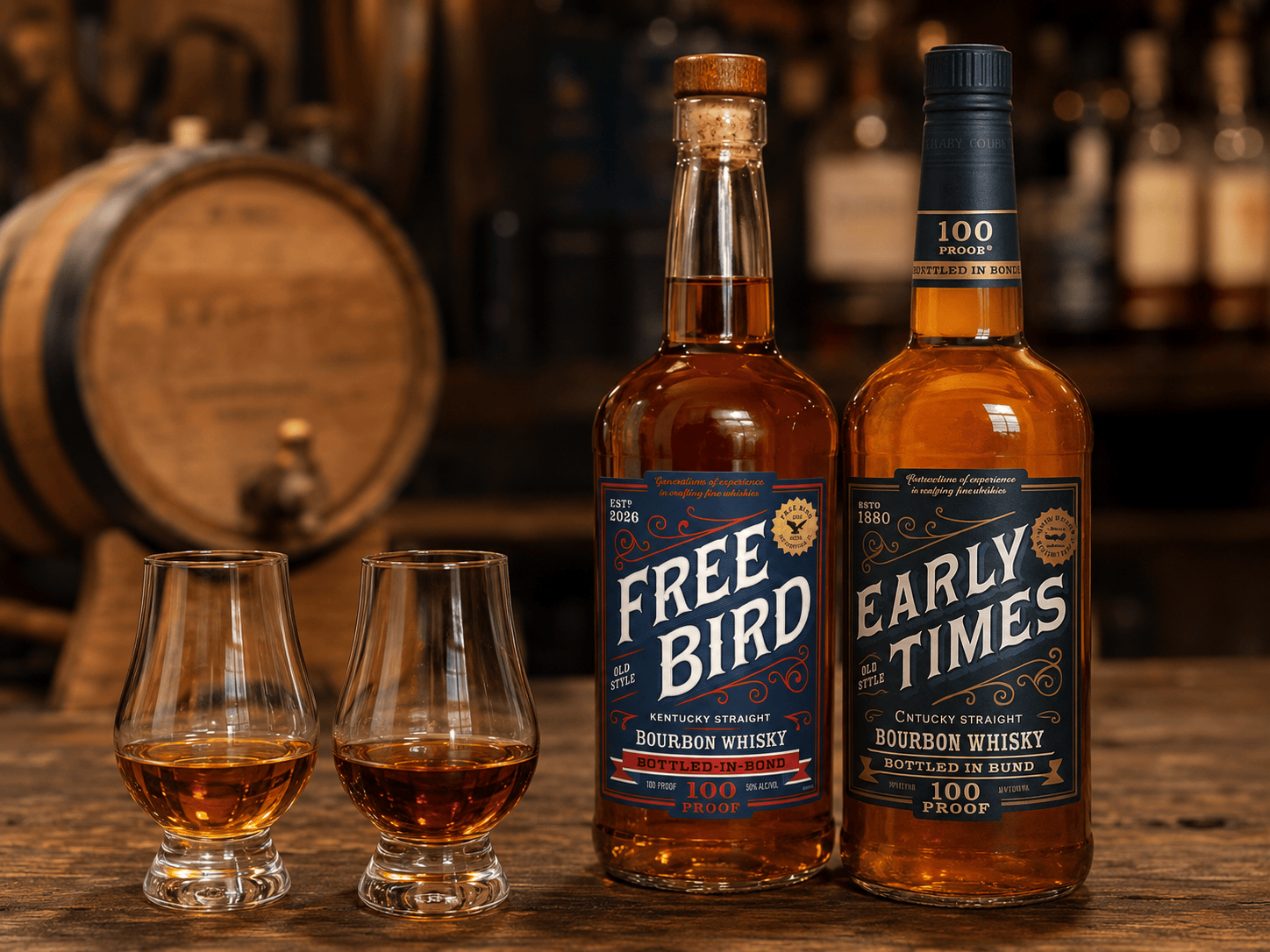 I named this one Free Bird, in honor of the United States’ gold medal-winning hockey team. Since I was heading to Kentucky for a Bourbon Trail trip this week, I brought a bottle with me to give to Scott. Naturally, we had to open a fresh bottle of Early Times and pour samples of both the original and the barrel-finished version side by side.
That seemed only fair.
And delicious.
Color
The Free Bird clearly has the edge here. There is a full shade of difference between the two glasses, with the barrel-finished version showing deeper color and a little more richness before it ever gets to the nose.
Nose
The standard Early Times is sweet and inviting, with tree fruit, brown sugar and caramel doing most of the work. There is a little oak there, but it stays mostly in the background.
On the Free Bird, the oak moves forward just enough to make its presence known without taking over. The fruit also shifts a bit, leaning richer and redder, while the brown sugar and caramel notes still hold their place. Again, the Free Bird wins.
Palate
The Early Times leads with a noticeable peanut note, followed by tree fruit, caramel, cinnamon and brown sugar. For a sub-$20 bottled-in-bond bourbon, it punches well above its weight.
The Free Bird keeps all of that, but the balance changes. The peanuts step back. The fruit steps forward. The cinnamon and caramel feel a little more integrated. The barrel didn’t turn Early Times into something unrecognizable, which is good. It just gave it a little more polish.
Advantage, Free Bird.
Mouthfeel
The three-ish months in the finishing barrel added just a touch of viscosity to the Free Bird. It is not suddenly thick or syrupy, but it has a little more body and a slightly better coating quality.
That gives it the nod over the regular Early Times, which is already surprisingly creamy for a budget bourbon.
Finish
With the improved mouthfeel, the Free Bird lingers just a bit longer, carrying sweet cinnamon, caramel and a touch of oak. The standard Early Times is not bad at all. The caramel and brown sugar hang on better than you might expect.
But the Free Bird is just a touch better.
Verdict
The finishing barrel worked its magic again.
Early Times Bottled-in-Bond was already one of the better budget bottles on the shelf, but after three months in the barrel, it picked up color, depth, oak structure and a little extra richness without losing what made it good in the first place.
I have several bottles of Early Times in reserve, which I’m glad about because the 1792-produced version has been getting some rough early reviews. The regular Early Times will remain a frequent budget pour for me.
But my two bottles of Free Bird will have a more honored place on the shelf.
They won’t be everyday pours. They’ll be saved for more special nights.
Now the barrel moves on to its fifth fill: Old Forester 100 Rye.
More on that in about three months.
