
I didn’t really know whiskey when I started drinking bourbon close to 20 years ago. I knew what I liked, or at least I thought I did. I knew when something seemed smoother than something else. I knew when a bottle felt special. I knew when a pour seemed stronger, richer or more interesting than what I had been drinking before. But I didn’t yet have the vocabulary—or the experience—to explain why.
My tastes have changed since then. What seemed amazing then can seem fairly simple now. What once seemed high proof can now seem merely complex. And some bottles I once thought were extraordinary don’t hold quite the same place in my mind anymore.
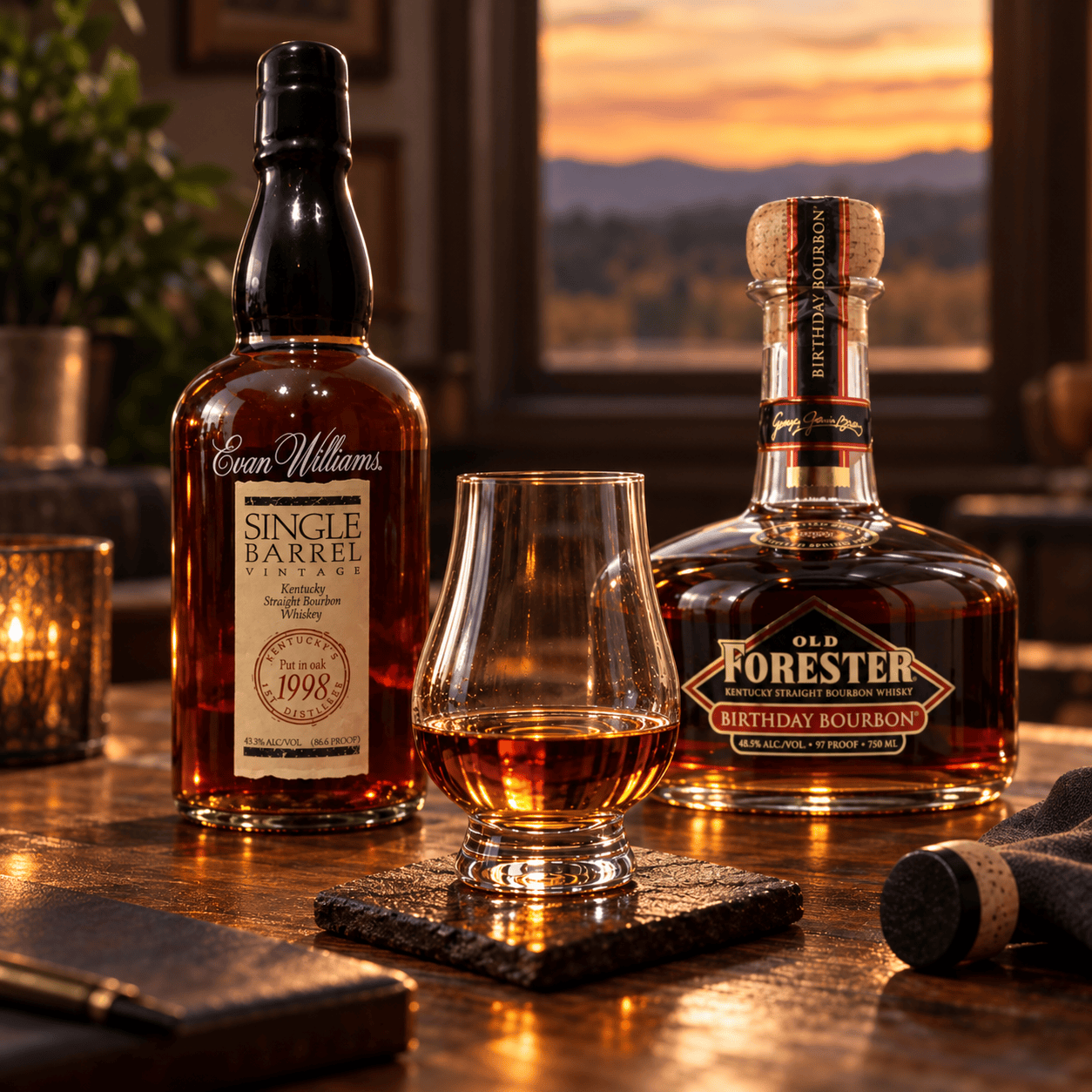 One of my first really good bottles was an Old Forester Birthday Bourbon. It was 97 proof, which seemed substantial enough at the time. That bottle has long since been consumed, although I still have the empty bottle on the shelf. Around the same time, I picked up an Evan Williams Single Barrel. That one comes in at 86.6 proof, and I still have some of it left.
Years ago, I thought that bottle was something special. Now, it’s fine. And that isn’t because I’ve become some sort of proof snob. I still enjoy plenty of lower-proof whiskey. Proof can bring intensity, but intensity and quality are not the same thing.
What I find missing in that old Evan Williams now is viscosity and complexity. It doesn’t give me much to work through. There aren’t layers waiting to reveal themselves, and there isn’t much mystery in the glass. These days, that’s one of the things I enjoy most about bourbon: trying to figure out what makes it tick.
Why does one pour begin sweet and finish spicy? Why does another seem thin on the palate but explode on the finish? Why does a note I missed on the first sip suddenly become obvious on the third? Why does one bottle seem simple today and surprisingly interesting a month later? Experience changes the way we taste, and life changes the way we understand almost everything else.
There are passages of Scripture I read years ago and thought I understood. I probably did understand them, at least as much as I was capable of understanding them then. But when I come back to them now, they sometimes taste different. The words haven’t changed. God hasn’t changed. I have.
A verse about grief means something different after you’ve buried people you love. A passage about forgiveness sounds different after you’ve been hurt badly enough to discover how difficult forgiveness can be. A promise about God’s faithfulness carries more weight after you’ve lived long enough to look backward and recognize places where He was faithful even when you couldn’t see it at the time.
Even familiar truths can develop new depth. That doesn’t mean Scripture is changing to fit us. It means experience sometimes gives us the ability to notice things we once passed over. The same thing can happen in the other direction. Ideas that once sounded profound may seem thinner after years of testing them against Scripture and life. Things we once accepted quickly may deserve another look.
Spiritual maturity isn’t simply collecting more information. Sometimes it means returning to familiar ground and discovering that we didn’t understand it nearly as well as we thought. That can be humbling, but it can also be wonderful, because maturity isn’t always about finding something new. Sometimes it is about returning to something old with better senses.
That bottle of Evan Williams hasn’t changed while it has been sitting on my shelf. What changed was the person pouring it. And when I return to an old passage of Scripture, an old prayer or a truth I first encountered decades ago, I sometimes discover the same thing.
The first sip told me something about what was in the glass. The sip years later tells me something about what has changed in me. And sometimes that second tasting is where the real complexity begins. Enjoyed this? Subscribe and get future reflections, bourbon notes, and assorted nonsense delivered straight to your inbox.
Copyright © 2026 Doug DeBolt.
