
Childhood has a way of making the world seem simple. A friend is a friend. A baseball card is a treasure. An afternoon at the café is just an afternoon.
Until something happens that makes the world more complicated.
The Same Name is a story about friendship, prejudice, and the moment when one boy begins to understand that adults do not always see people the way children do.
The Same Name
by Oz Whittaker
It was the fall of 1973, and I was ten years old—old enough to know when something felt unfair, but not old enough to do much about it. Teacher planning days were the worst. At my school, they meant no classes, no friends, and nothing to do but hang around the house. This time, Mama said I couldn’t stay home alone, so she brought me with her to the school where she taught across town.
Christina, my four-year-old sister, went to Mrs. Miller’s for the day because, as Mama said, she was too little to run around a big school. Jesse, my fifteen-year-old brother, stayed home to do as he pleased.
I’d never been inside Mama’s school before. The hallways smelled like pencil shavings and chalk dust, and my footsteps echoed like I was walking in a cave. She told me to sit quiet in her classroom while she worked, but after a while I wandered into the gym. That’s where I saw him.
He was about my age, maybe a little taller, standing near the stage with his hands shoved in his pockets. His T-shirt was so faded I couldn’t make out what it once said. He looked at me the way a dog looks at another dog through a fence—curious, but not sure if it was worth barking.
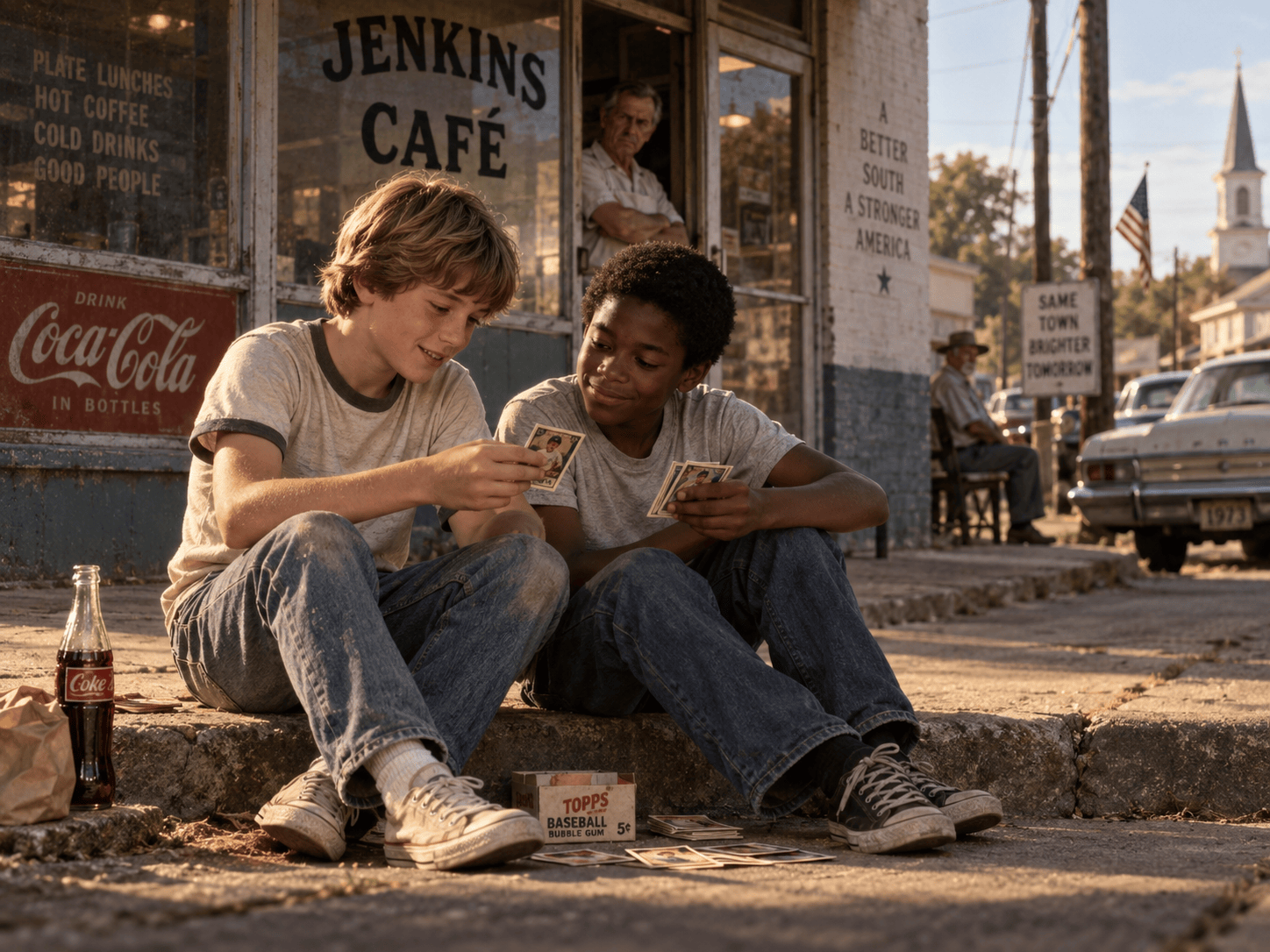 I didn’t know any Black kids. Where I lived, everybody was white. I guess the same was true for him, only the other way around. For a long minute we just stared, like neither of us wanted to make the first move.
Then I reached in my pocket and pulled out my best catseye marble. It was blue and green, swirled like the world seen from outer space. I rolled it in my palm so it caught the light. His eyes followed it, and finally he smiled.
“Nice one,” he said. His voice was low, but friendly. “Shoots straight?”
I grinned and flicked it across the gym floor. It clicked against the wood and spun in a wide circle. “Best one I got,” I told him.
He walked over, squatted down, and picked it up. Held it like it was a diamond. Then he handed it back to me. “I’m Marcus,” he said.
“Danny,” I said. “Danny Davis.”
His eyebrows went up. “Davis? That’s me too. Marcus Davis.”
I laughed. “No kidding? We might be cousins or something.”
He shook his head, not mean, just matter-of-fact. “Nah. Trust me, we ain’t.”
A little while later, Mama came into the gym with her arms full of papers. She stopped when she saw us crouched over the marbles.
“Well now,” she said. “Marcus Davis. What are you doing here today?”
“Hi, Mrs. Davis,” he said quickly. “I thought we had school.”
Mama tilted her head. “No school today, Marcus. You know that.”
He looked down at his shoes. “Guess I forgot.”
She studied him a second, then softened. “Well, you’re here now. You eaten anything yet?”
He shook his head.
“Then you’ll come with us,” she said. “Danny, get your things.”
We piled into Mama’s Dodge, Marcus squeezed between us on the bench seat. The windows were rolled down, hot air rushing in with the smell of orange groves. Mama asked about his sister, and Marcus perked up.
“She still chews on my pencils,” he said, grinning.
Mama laughed. “That sounds about right for her age.”
We pulled up to Jenkins Café. Mama walked us inside, chin high. The little bell over the door jingled, and right away forks froze and people stared. We slid into a booth, and before we could order, Mr. Jenkins himself came over, wiping his hands on a rag.
“Jess,” he said, smiling at her. “Good to see you.” Then his eyes landed on Marcus. The smile drained away. “But you know we don’t serve his kind here. If you want something for him, you can pick it up in the back.”
Mama’s lips pressed tight. “Now, Earl,” she said evenly, “this boy’s one of mine. He deserves a plate the same as any child in this town.”
Jenkins shook his head. “Jess, you know how it is. Folks wouldn’t like it.”
She didn’t budge. “What folks like and what’s right aren’t always the same thing.”
He shifted, looking at the other tables. “Can’t do it. Not here.”
For a moment I thought she’d keep fighting. Instead she stood, reaching for my hand and holding her other one out to Marcus. “C’mon, boys. Seems they don’t want our business here.”
The café was so quiet I could hear the clock ticking on the wall. Mr. Jenkins opened his mouth, but Mama cut him off.
“It’ll be a cold day in hell before I spend one red cent in this place again.”
Nobody followed us out, but I could feel the stares drilling into my back.
Mama drove us to McDonald’s instead. She parked, turned to us, and said firmly, “Stay here.” Marcus and I waited in silence until she came back with two paper sacks and three drinks balanced in a tray. The smell of fries filled the car.
Back at the school, we carried everything into the cafeteria. The place was dark and empty, with long rows of tables stretching like a ghost town. We unwrapped our burgers and ate in silence, the only sound the low rumble of the refrigerators humming in the kitchen.
“You got ketchup on your nose,” Marcus said suddenly.
I scrubbed at my face with a napkin.
“Missed,” he said, grinning.
Mama smirked. “Still there.”
Marcus laughed so hard Coke sprayed out his nose. I laughed too, and even Mama joined in, shaking her head. The cafeteria didn’t feel empty anymore—it sounded alive.
When the laughter quieted, I asked, “You got brothers or sisters?”
“Little sister,” Marcus said. “She’s five. Always chewing on my pencils.” He grinned. “What about you?”
“Older brother, Jesse. He’s fifteen and thinks he knows everything. And a little sister, Christina. She’s four. Mama left her with Mrs. Miller today.”
Marcus nodded. “My mama cleans houses over on the east side. My daddy works construction. Long hours. He’s gone most days.”
“Mine sells appliances,” I said. “Fridges, washers, stuff like that. I see him on weekends mostly, since…” I trailed off.
Marcus studied me a second, then shrugged. “At least you get to see him.”
I didn’t know what to say, so I slid the last of my fries toward him. “Want ’em?”
“Don’t mind if I do.”
That was when Mama came back with two beat-up gloves and a scuffed baseball. “Thought you boys could use these,” she said, her eyes twinkling.
We stepped outside into the schoolyard, the grass patchy and worn. I lobbed the ball, and Marcus caught it easy. He zipped it back, and I had to jump to snag it.
“Nice,” I said.
“Better than marbles,” he shot back.
Pretty soon we were firing it hard, the smack of leather echoing across the yard. Marcus whooped when he made a diving grab, and I whooped when I caught one over my head. For a while, we weren’t two kids from different sides of town. We were just ballplayers.
But when I chased one throw too far, I noticed two men leaning against the fence, watching. Their faces didn’t change, but their eyes stayed on me longer than on Marcus. Like they were trying to figure out what a white boy was doing here.
I looked away and threw the ball back. I didn’t say anything to Marcus.
Mama sat on the steps with her papers, watching us. She didn’t say a word, just let us play until the sun started to fall.
When she finally called us in, Marcus and I dragged our feet toward the car. My glove dangled at my side, but in my pocket I felt the weight of my marbles and cards. I pulled them out—my best catseye, a couple of shooters, and two cards I’d guarded like treasure: Roberto Clemente and Willie Stargell. Two of my favorites.
“Here,” I said, holding them out.
Marcus stared. “What’s this?”
“They’re yours. To start your collection.”
His eyes went wide. “Clemente and Stargell? No way. You’re crazy.”
“I got more at home,” I lied. “Take ’em.”
He hesitated, then closed his hands around them like they might break. His voice dropped to a whisper. “I’ll keep ’em forever.”
Mama was watching. She didn’t say anything until we were driving home. Christina was bouncing on the seat beside me—we’d picked her up from Mrs. Miller’s.
“Danny’s got a new best friend!” she chirped.
Mama reached over and squeezed my knee. “I’m proud of you, son.”
I didn’t understand what she meant. Not then. All I knew was that Marcus had the two best players in my pocket, and a piece of me along with them.
A few months later, on my birthday, Mama handed me a wrapped box. Inside was a stack of new baseball cards and a cloth bag of marbles. Right on top was another Clemente, and just beneath it, a Stargell.
“I noticed what you gave away,” she said softly. “Figured you ought to have these back.”
I swallowed hard and nodded, but I didn’t tell her the truth—that the ones I gave Marcus weren’t just cards and glass. They were two of my favorites, and they belonged to him now.
Later I asked, “Can Marcus come over sometime? We could play catch in the yard.”
Mama smiled, but it faded quick. “That’s a good idea. We’ll see.”
Weeks passed. When I asked again, she shook her head. “His family moved. I’m not sure where.”
I went quiet. I still had the new cards, the new marbles, the memory of the birthday cake on the table. But all I wanted was to see Marcus running up the street, Clemente safe in his pocket.
I never did.
© 2025 Cap’n Pen’s Press. All rights reserved.
No part of this story may be reproduced, distributed, or transmitted in any form without the prior written permission of the author.

This is such a beautiful and well written story. It reminded me of a few of my own childhood encounters; much the same mindset and similar outcomes. The line, “old enough to know when something felt unfair, but not old enough to do much about it” was exactly my experience. Thank you for sharing.
Thank you for your feedback! This story hit close to home for me, and there’s a lot in here that reminds me of things the way they used to be when I was a kid. It’s good to be finally writing and sharing things with other people. I spent too much of my time thinking about writing and not enough actually doing it.