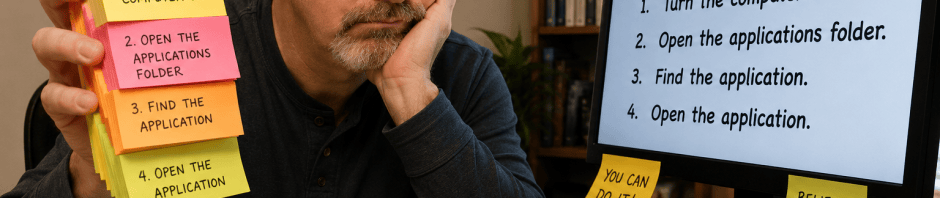


I consider the basic operation of a computer to be, well, basic.
I’m not talking about writing code, building a motherboard or hacking into a government satellite. I mean turning on the computer, opening a program, finding a file, saving it somewhere sensible and attaching it to an email without summoning the nearest teenager.
Apparently, that expectation is unreasonable.
Over the years, I’ve walked a lot of people through simple computer tasks. More than once, the person has pulled out a notepad—or worse, a pad of Post-it notes—and begun writing down every step.
- Turn the computer on.
- Open the applications folder.
- Find the application.
- Open the application.
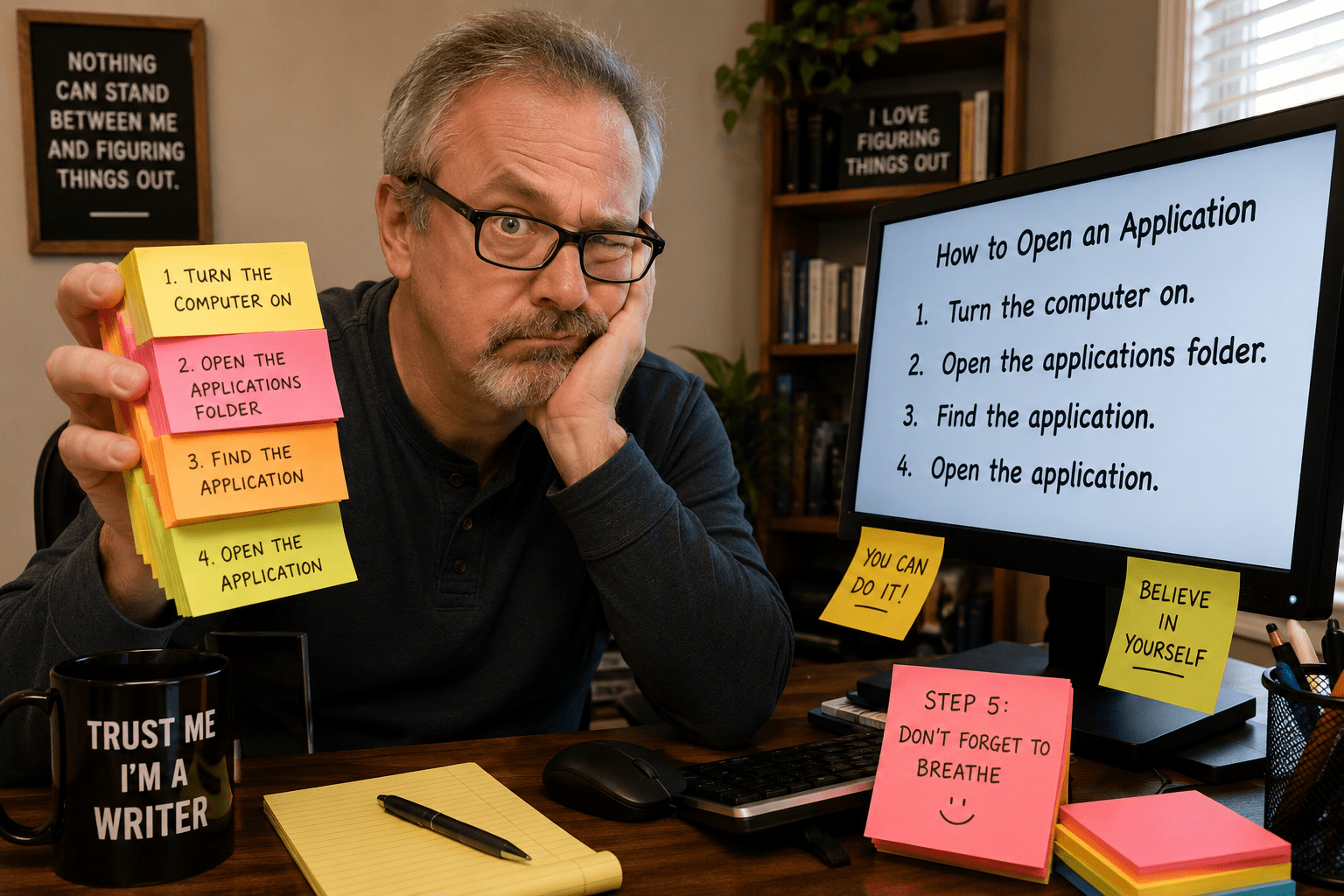 At that point, I usually begin wondering whether we are learning to use the computer or leaving instructions for future archaeologists.
Nothing drains my confidence faster than watching someone create a handwritten operating manual for a process that takes four mouse clicks. It feels a little like trying to teach a blind man how to see. I’m saying, “Just look at what’s on the screen,” while the other person is recording, “Step seven: Look at screen.”
And yes, I know that everyone learns differently. I know some people need things written down. I know patience is a virtue. I also know that somewhere around the third Post-it note, my eyes may roll hard enough to affect the Earth’s rotation.
My approach to computers has always been different. I tend to assume there is a way to do whatever I’m trying to do, and if I keep poking around long enough, I’ll find it. I click things. I open menus. I test possibilities. Sometimes I make a mess, but I usually learn something while cleaning it up.
When I went to work at the newspaper in Harlingen, there was a new computer program that was apparently taking people about three months to learn. Before I started, Dad told me not to get frustrated and quit on it.
That was exactly the wrong thing to say to me.
His assumption that I might quit made me mad enough to decide I would learn the program in one month.
And I did.
I’m sure part of that was stubbornness. In fact, most of it was probably stubbornness. But stubbornness can be an excellent educational tool when properly aimed. I decided the program was not going to beat me, so it didn’t.
That may be the biggest difference between people who are comfortable with computers and those who are not. Some people sit down already convinced the machine is too complicated. Once they decide it will be hard, every unfamiliar button becomes proof that they were right.
Others decide that nothing is going to stand between them and figuring it out. They may not know the answer yet, but they assume the answer exists. Then they keep looking until they find it.
Computers are not the only place where I experience this strange disconnect. Singing has always felt fairly natural to me. I hear a note and generally know whether I’m matching it. Then I remember that some people can sing the same wrong note with tremendous confidence from the beginning of the song to the end.
Writing feels basic to me, too, even though I know it isn’t. Put the words in an order that makes sense. Use punctuation. Read the sentence again and make sure it says what you meant. Yet I’ve read enough student essays, emails and social media posts to realize that this process is apparently more mysterious than I once believed.
The same is true of basic math. I’m not talking about calculus. I mean percentages, making change and estimating whether the total at the register is somewhere in the neighborhood of correct. If you buy three things that cost about $10 each and the total comes to $94, this should at least produce a raised eyebrow.
Of course, I have my own supposedly basic skills that remain stubbornly unmastered. Listening comes immediately to mind. I wish I did it better. I can write, sing, calculate a percentage and usually find a missing computer file, but I can still catch myself planning what I’m going to say while someone else is talking.
So perhaps we all have skills that seem obvious to us only because they happen to fit the way our brains work.
Still, if I’m walking you through a simple computer task and you pull out a pad of Post-it notes, don’t be surprised if you catch an eye-roll.
I’ll try to control it.
But I make no promises.
Enjoyed this? Subscribe and get future reflections, bourbon notes, and assorted nonsense delivered straight to your inbox.
Copyright © 2026 Doug DeBolt.

I totally agree with you on this one i mean i may not possess high iq but there are things that i could say that i have knowledge things that i can’t and i forget then i do i do agree with you in the post it’s i mean i have one especially when i open my laptop but it’s not a written piece of paper but a note when i open my laptop and the desktop there goes my posted what should i do passwords or whatever
BB here..in the beginning, I must admit post a notes were my friend! 😉