
Before the name meant anything to the world, it belonged to a boy named Jasper.
He was small for his age, quick on his feet and old enough to understand that nobody owed him an easy life. Childhood had not stayed gentle for long. There had been loss. There had been upheaval. There had been the kind of early uncertainty that teaches a boy to watch adults carefully and figure out where he might be useful before someone tells him he is in the way.
So Jasper made himself useful.
 At first, that meant small work. He carried what stronger arms did not want to bother with. He swept corners that would only be dirty again by morning. He fetched things, held things, moved things and learned to stand close enough to be helpful without standing so close that someone told him to move. He listened more than he spoke, not because he lacked opinions, but because a boy in his position learned quickly that listening was often safer.
The place had its own rhythm. Morning brought one set of chores. Heat brought another. Some work required strength. Some required patience. Some required knowing exactly when to leave a thing alone. Jasper did not know those differences yet, but he was beginning to learn that every task had an order, and every order had a reason.
That was where Nate came in.
Nate was not the owner. He was not the man whose name people were likely to put at the center of the story. But when something needed to be done correctly, people looked toward him. He moved like someone who had already made the mistakes younger men were still waiting to make. He knew the tools, the timing, the order of the work and the small signs that separated “almost right” from “ruined.” He knew when a boy was helping and when a boy was about two seconds from damaging something important.
Jasper noticed.
That may have been one of his gifts. He noticed things. He noticed that Nate did not waste motion. He noticed that Nate did not rush when rushing would only make more work later. He noticed that the older man could glance at a task and understand what someone else would need five minutes to discover. Jasper did not yet know how Nate knew. He only knew Nate knew.
So he watched him.
Sometimes Nate gave him a task simple enough that a boy could not do much damage. Sometimes he made him do it again because the first attempt was sloppy. Sometimes he stopped him before his hand went where it should not go. Sometimes he said nothing at all, and Jasper had to learn whether that silence meant “good enough” or “look again.”
Those were not grand lessons. They were not the sort of lessons anyone would write down later with golden light around them. They were ordinary lessons, which is usually how important things are first learned.
Carry this. Not that way. Wait. Watch. Try again. Look closer. Do it until you know why you are doing it.
Jasper was still a boy, so he probably did what boys do. He got impatient. He wanted to be trusted with more than he had earned. He likely thought some jobs were beneath him until he learned that small jobs are where careless people reveal themselves. But if he was restless, he was also alert. He paid attention to correction. He absorbed the habits of the place. He learned that pride could make a person sloppy, and sloppiness could spoil work that had taken time to prepare.
Nate did not have to announce himself as a teacher. In a place like that, teaching often came disguised as work. A boy learned because someone older let him stand nearby. A boy learned because someone corrected him before the mistake became expensive. A boy learned because the same task came back tomorrow, and tomorrow, and tomorrow, until his hands began to remember what his mind had not fully understood at first.
Over time, Jasper changed.
He was not simply the boy who swept and fetched anymore. He began to understand the pattern of the work. He began to see why things happened in a certain order. He learned that good work was not one dramatic act, but a long chain of small decisions made correctly. He learned that the person who appears calm in the middle of complicated work is often calm because he has already spent years learning what deserves panic and what does not.
A young person can receive a great gift that way without recognizing it immediately. At the time, it may just feel like being told what to do. Later, if the young person is wise, he realizes he had been standing next to an education.
Jasper was standing next to Nate.
That did not mean Jasper’s future was handed to him. He still had to grow into it. He still had to work, risk, decide, build and become. A teacher can pass along knowledge, but the student still has to carry it. Jasper carried it. He had energy, ambition and enough hunger for a future that he did not remain merely a boy with chores. He became a young man with a craft.
And then he became more than that.
 As the years moved on, Jasper’s name began to matter. People connected the work with him. They trusted what came from him. His reputation traveled farther than the little world where he had first learned the difference between doing something and doing it well. Eventually, the name that had once belonged only to a boy became attached to something much larger.
That is often how history works. The student steps forward because the student builds the business, signs the papers, takes the risk and becomes the public face. The teacher remains closer to the beginning, where fewer people are looking. Those who were there may remember. Families may remember. Neighbors may remember. But the wider world usually wants one name, one face and one simple story.
For a long time, that is mostly what it got.
 One name. One legend. One label.
That label remembered the student more clearly than the teacher. It remembered the man who carried the story forward, but not always the man who helped place the craft in his hands. It remembered the public name, the marketable name, the name that would travel.
But before the label, there was apprenticeship. Before the world knew the student, the student had watched the teacher. Before one name became famous, two men stood near the beginning of the story.
One was learning.
One was teaching.
And near the end, we can finally stop hiding the names.
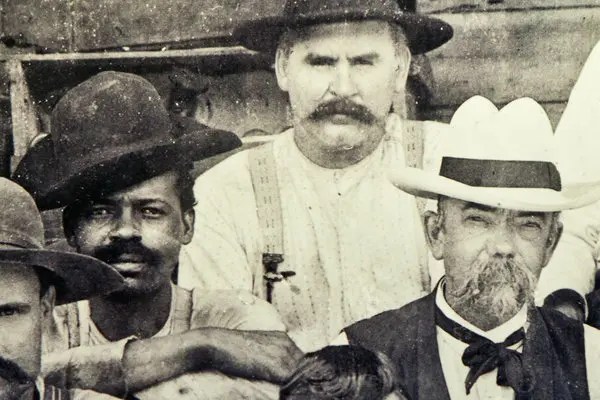 The boy named Jasper was Jasper Newton Daniel, the young apprentice the world would come to know simply as Jack.
And the man named Nate was Nathan “Nearest” Green, the enslaved man who became a free man, a master distiller and one of the essential teachers behind the whiskey that would one day carry Jack Daniel’s name around the world.
That truth does not ruin the legend.
It completes it.
 Now, when you see that famous label, you may still see the name the world remembers first. But maybe you will also see the boy who had to learn before he could lead. Maybe you will see the teacher whose hands helped shape the craft before his name received the honor it deserved. Maybe you will see both the student and the teacher, the public name and the quieter one, the label and the life behind it.
And once you know that, you cannot quite look at the bottle the same way again.
Not because the story is smaller.
Because it is fuller.
Because now you know the story in between the lines.
Enjoyed this? Subscribe and get future reflections, bourbon notes, and assorted nonsense delivered straight to your inbox.
Copyright © 2026 Doug DeBolt.
