
For a lot of people, tonight’s bourbon will be whatever they grab on the way home. Maybe they’re headed to a party. Maybe they’re traveling. Maybe they just want enough whiskey for one drink without committing to an entire bottle.
That’s where those little plastic bottles come in.
And, let’s be honest, a lot of what you find in those things is pretty bad.
But does it have to be?
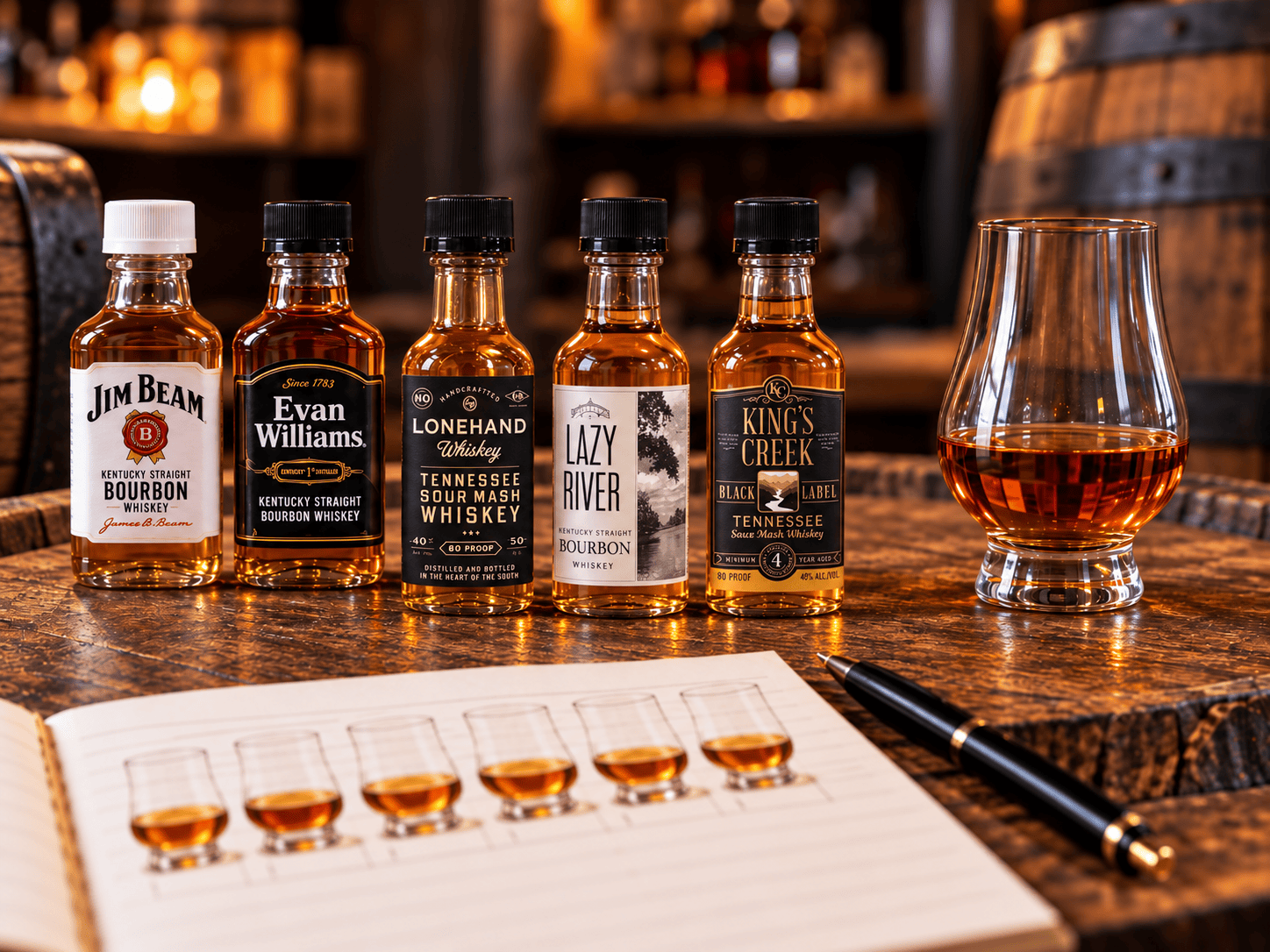 That seemed like a perfectly reasonable question for the Bourbon Cheapskate, especially when I noticed Total Wine had a collection of minis for less than $2 apiece. At that price, there wasn’t much risk involved. Worst-case scenario, I’d spend less than $10 discovering five bourbons I never needed to drink again.
Then another idea occurred to me.
What if the individual whiskeys weren’t very good, but they could help each other?
So I picked up five sub-$2 bottles: Jim Beam, Evan Williams, Lone Hand, Lazy River and King’s Creek. Then I poured equal portions of each into another bottle to create my own extremely small-batch bourbon, complete with a production run measured in ounces rather than barrels.
That gave me six samples to taste blind: the five original bourbons and my homemade infinity blend.
Could five cheap bourbons combine to become something better?
There was only one way to find out.
The Blind Tasting
A — 67.54
The color is honey to light amber. The nose is a bit sour, almost like sour cherries, with some vanilla, caramel and maybe a touch of cinnamon.
The palate is very light and basic: vanilla, cinnamon, bits of caramel and cherry. The mouthfeel is extremely thin, and the finish follows the same path, offering a little tart oak, cherry and baking spice before disappearing quickly.
There isn’t anything particularly offensive here. There just isn’t much here at all.
Score: 67.54
B — 72.10
Big surprise immediately: light copper color.
The nose brings solid peanut butter, which naturally makes me start thinking Jim Beam, but we’re making no predictions yet. Anything can happen in a blind tasting. Dusty peanut shells join vanilla and caramel.
The palate leads with brown sugar, peanuts, vanilla and caramel, while a little baking spice leaks through underneath. The mouthfeel is a touch better than A, although still pretty thin.
The finish is the biggest improvement, bringing cinnamon apples lightly dipped in peanut butter.
Not bad.
Score: 72.10
C — 72.97
Another surprise: more light copper.
The nose is remarkably similar to B, with plenty of peanut shells, vanilla and caramel, plus a touch of nutmeg. In fact, at first sniff this is almost a carbon copy.
The palate stays in familiar territory with sweet brown sugar, cinnamon, caramel and vanilla. There may be a hint of tree fruit along with a little tart oak.
The mouthfeel improves slightly, and the finish is perfectly acceptable, leaving behind tart oak, vanilla and cinnamon.
We’re not exactly entering allocated-bourbon territory here, but this one is doing its job.
Score: 72.97
D — 72.75
The color heads back toward the lighter end of the spectrum, somewhere between honey and light amber, and the nose follows suit.
Peanuts, light tree fruit, vanilla and nutmeg introduce a palate that remains fairly tame. There are some pleasant cinnamon-caramel apples, vanilla and a touch of oak, but none of the flavors are particularly bold.
Even so, this might be the most complex sample so far.
The mouthfeel actually shows a little viscosity, and while the finish is on the quick side, it’s enjoyable: peanuts, cinnamon, caramel and vanilla.
Score: 72.75
E — 73.40
Now we finally get some color.
E is deep amber, with a slightly sour nose led by apples, vanilla, honey and nutmeg.
The palate reflects the nose, but everything seems to deepen a little. Honey becomes more prominent and is joined by cinnamon, warm caramel, vanilla and a touch of tree fruit.
This might be the best sample so far.
The mouthfeel remains fairly thin—there seems to be no escaping that tonight—but the finish is tasty even if it doesn’t stay long. Tart fruit, honey and spice provide a pleasant closing act.
Score: 73.40
F — 72.53
Our mystery blend pours mid-amber.
The nose is fairly light, with toasted nuts, vanilla and caramel. The palate is sweet, bringing another combination of honey and cinnamon along with buttery toffee, vanilla and a touch of tart oak.
The mouthfeel is, predictably, thin.
But the finish lasts longer than expected. Tart apples, oak, baking spice and vanilla linger enough to make this one more interesting than I anticipated.
Score: 72.53
The Reveal
And now we find out exactly what less than $2 can buy.
A — King’s Creek — 67.54
Well, this one didn’t surprise me.
The only other time I had King’s Creek, I thought it was worthy of being poured down the sink. It wasn’t quite that bad tonight, which I suppose counts as progress, but it still finished comfortably at the bottom of the field.
Thin, simple and mostly forgettable, King’s Creek never really developed beyond a few basic bourbon notes.
I wouldn’t call it a drain pour this time.
I’m also not planning a King’s Creek vertical anytime soon.
B — Jim Beam — 72.10
No shock here.
The peanut character was practically carrying identification, and Jim Beam delivered exactly the kind of profile I expected. Brown sugar, peanuts, caramel and vanilla made this familiar, dependable and perfectly drinkable.
It didn’t do anything spectacular, but at this price that probably isn’t the assignment anyway.
C — Evan Williams — 72.97
This was one of the more interesting reveals because I thought B and C were extremely similar.
Evan Williams edged Beam with slightly better mouthfeel and just enough additional fruit and oak to separate itself. Again, nothing here is particularly complex or memorable, but this was a completely respectable showing for a whiskey poured from a tiny plastic bottle.
D — Lazy River — 72.75
Lazy River was another pleasant surprise.
It lacked intensity, but it may have offered the most complexity of the first four samples. The cinnamon-caramel apple note gave it some personality, and the slightly improved mouthfeel helped it stand out.
This was probably the bottle I knew the least about going into the tasting, and it held its own nicely.
E — Lone Hand — 73.40
And our champion is Lone Hand.
I certainly wasn’t expecting that when we started.
It had the deepest color, one of the more interesting noses and the best combination of honey, fruit, caramel and spice in the group. The score still tells us exactly what this is: a modest bourbon with clear limitations.
But among five bourbons costing less than a couple of bucks for a mini, somebody has to win.
Tonight, it was Lone Hand.
F — The Infinity Blend — 72.53
And there goes my budding career as a master blender.
The experiment didn’t produce something better than all five component bourbons. In fact, the infinity bottle finished fourth among the six samples, behind Lone Hand, Evan Williams and Lazy River.
But I’m not sure that means the experiment failed.
King’s Creek scored 67.54 on its own and was easily the weakest bottle on the table. Once blended with the other four bourbons, its rougher edges disappeared into something far more balanced. The infinity blend developed sweeter honey and toffee notes, a little more spice and a finish that lasted longer than expected.
So the blend didn’t create something great.
What it did was take the worst bourbon in the group and make sure I couldn’t taste it anymore.
There may be a lesson there.
The Cheapskate Verdict
Let’s establish the proper perspective here. None of these are bourbons I’d recommend buying by the case, and nobody is lining up overnight for the next Lone Hand allocation.
But that really wasn’t the assignment.
These are bourbons you can buy for less than $2 when you need a small amount of whiskey, and four of the five individual bottles landed in a remarkably narrow range between 72.10 and 73.40. That’s not great bourbon, but it’s considerably better than the plastic bottle might lead you to expect.
Lone Hand was the surprise winner at 73.40, narrowly ahead of Evan Williams at 72.97 and Lazy River at 72.75. Jim Beam remained dependable at 72.10.
King’s Creek brought up the rear at 67.54, which was entirely consistent with my previous experience with it.
And our homemade “small batch”?
72.53.
It didn’t turn five bargain bourbons into premium whiskey. Apparently blending doesn’t work like Captain Planet, where combining five mediocre powers suddenly creates something spectacular.
But it did make King’s Creek taste better.
For less than $10, I got five bourbons, a sixth whiskey of my own creation and an evening’s entertainment.
That sounds pretty Cheapskate to me.
Enjoyed this? Subscribe and get future reflections, bourbon notes, and assorted nonsense delivered straight to your inbox.
Copyright © 2026 Doug DeBolt.
