


WordPress really does seem obsessed with travel. Yesterday it wanted my best tip for budget travel. Today it asks, “What’s the longest trip you’ve ever taken?” That one I can actually answer.
When I was 18, my mom and stepdad led a tour of the Holy Land. And I mean just 18. My birthday was October 27, and that day I voted for the first time. Two days later, on October 29, we were on our way to Israel.
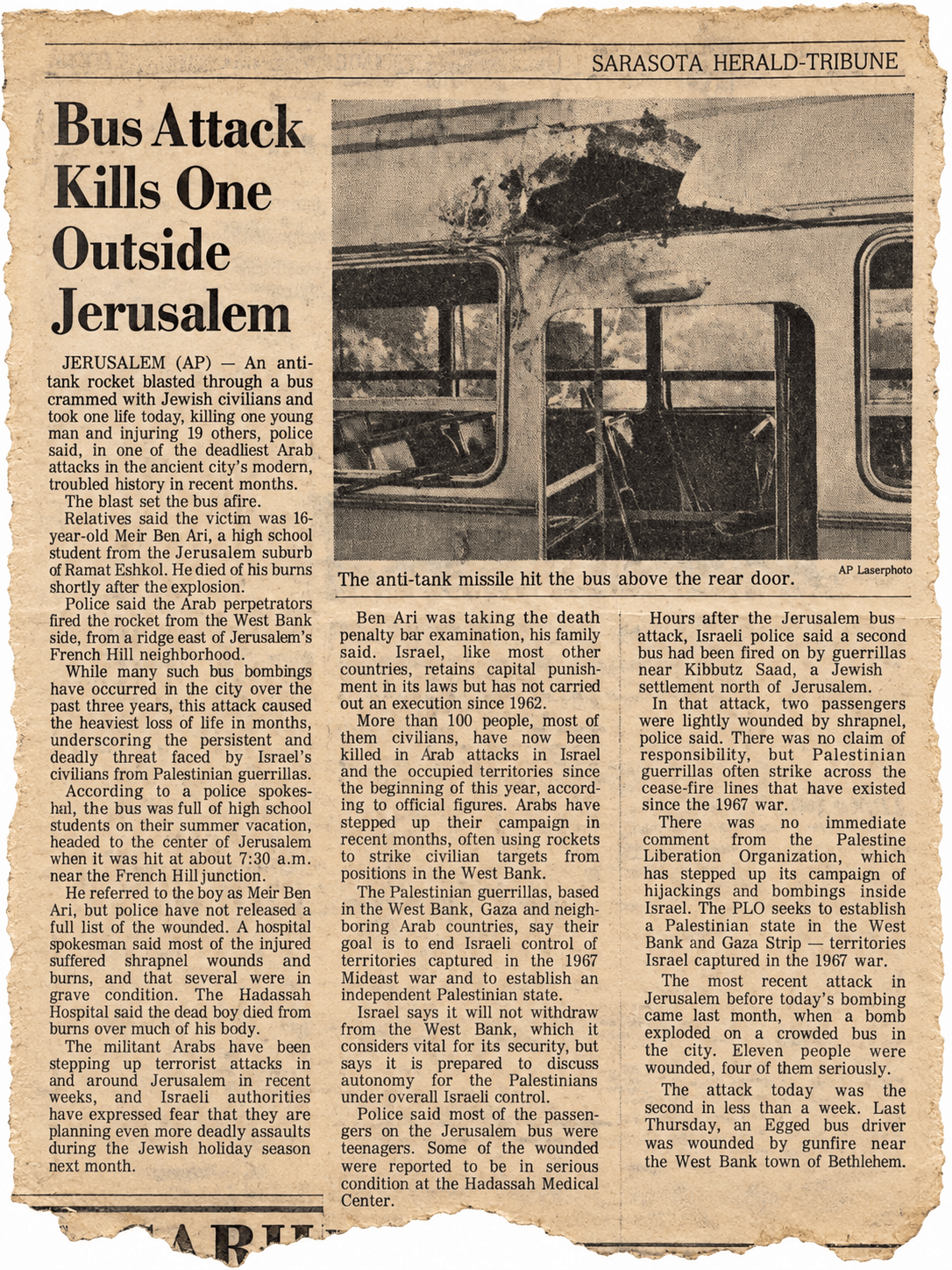 We started by taking a bus from Sarasota to Miami. Almost everyone on the trip was considerably older than I was, except for one girl named Judy Brown. Before we ever got on the airplane, though, there was a reminder that Israel wasn’t simply a place of biblical history and religious tourism. That morning’s newspaper carried a story about a bus outside Jerusalem that had been hit by a terrorist rocket. One person had been killed and others injured. I still have that clipping in my photo album.
When we got to Miami, El Al security came onto the bus and started checking everybody out. Guess which two people they pulled aside for individual questioning? Judy and me.
They asked us a ton of questions. Why are you going to Israel? Who do you know in Israel? What are you taking to someone in Israel? Did anyone in Israel ask you to bring them anything? Meanwhile, they were going through our luggage looking for whatever suspicious items we might have been carrying. Needless to say, Judy and I felt pretty safe once we finally got on the plane. If Israeli security was willing to interrogate two innocent teenagers traveling with a church tour, we figured anybody with genuinely nefarious intentions didn’t stand much of a chance.
 We flew from Miami to Montreal and then boarded a 747 for Tel Aviv. Somewhere along the way, I also learned a new meaning for the word “rent.” Mom had been talking with some Orthodox Jewish men, and when I asked her about the conversation, she told me they were traveling to a funeral and had rent their clothes. That confused me. Why would they rent clothes for a funeral? Couldn’t they afford to buy them? That was when Mom explained that “rent” meant torn — that they had torn their clothing as an expression of mourning. Apparently international travel was educational before we even landed.
Once we reached Israel, two of the first places we visited were the Wailing Wall and the Dome of the Rock. At the wall, I was struck by the seemingly endless prayers scrawled on scraps of paper and pushed into the cracks between those ancient stones. Thousands of private hopes, fears and petitions tucked into a place people had regarded as holy for centuries.
 Nearby, we saw a group of schoolchildren. Standing close to them were a couple of men carrying rifles. Our guide explained that they were dads making sure their children stayed safe. That was not a sight an 18-year-old from Sarasota was accustomed to seeing, and it immediately reminded me that Israel was not just ancient and sacred. It was also very real and very current.
That tension between ordinary life and military readiness showed up again later in Caesarea Philippi. On the way there, we encountered a convoy of military vehicles. That evening, we went out to look around town and saw soldiers carrying their weapons.
And they were watching First Blood.
There was something a little unsettling about watching armed soldiers thoroughly enjoying a movie in which Rambo was using very similar weapons to wipe out everyone trying to take him in. The soldiers seemed to be having a wonderful time. We eventually decided that perhaps heading back to the hotel was the better part of wisdom.
Don’t misunderstand me. I was very glad Israel had enthusiastic soldiers defending the country. I just didn’t particularly want to be standing nearby if anything suddenly gave them a reason to go to work.
 We also visited Yad Vashem, the Holocaust memorial in Jerusalem. I remember the trees there and being told about the people they honored. I understood it a little differently at the time, but the trees were planted in honor of the Righteous Among the Nations — non-Jews who had risked their lives to save Jews during the Holocaust. One of those names meant something to me immediately: Corrie ten Boom. She had died only recently, and I took a picture of her young tree. More than 40 years later, I still have that picture.
Some of my strongest memories, though, are of the places connected directly to the biblical story. I should add that what follows is based on what our guides told us at the time and what I remember more than four decades later. I’m not trying to settle archaeological disputes.
 The Garden Tomb may have been the most peaceful place I visited. Nearby is the rocky face that resembles a skull. Above it is a cemetery, and down below was the commotion of a busy bus station. Yet step inside the garden and somehow all of that seemed to disappear. There was simply peace.
We also visited the Church of the Holy Sepulchre, another traditional location for the crucifixion and burial of Jesus. It may very well mark the actual site, but my 18-year-old reaction was that it was mayhem inside — crowds, churches, shrines and activity everywhere. Even if that was the place, it didn’t feel like it. The Garden Tomb did.
 Then there was the Church of the Nativity in Bethlehem. What fascinated me was the cave beneath the church. We were told there was strong reason to believe the location was authentic, and the cave made sense to me. We tend to picture a wooden stable from Christmas cards and nativity sets, but wood wasn’t exactly something people in that part of the world wasted on barns. I can still picture that cave in my imagination as it might have been that night: dirty, smelly animals crowded inside, rough stone all around, and somewhere amid it all a rocky feeding trough holding a baby on a little clean straw. The Savior of the world arriving in perhaps the least impressive room imaginable.
We visited the Tombs of the Patriarchs as well. We were told that the actual burial chambers beneath the site had almost never been entered in modern times and that the identification of the place carried an extraordinary amount of tradition behind it. At 18, I didn’t need to crawl into a cave and inspect anything. Just standing near a place associated for centuries with Abraham, Isaac and Jacob was enough.
 Then there was the Sea of Galilee. I took one of the best photographs I’ve ever taken there, with sunlight breaking through the clouds over the water. I can still see that image in my mind.
At the Jordan River, my stepdad baptized a number of people from our group. Mom talked me into being one of them. I wasn’t interested at first, mostly for one deeply theological reason: I knew that water was going to be cold. I had been baptized as a baby, so this wasn’t about erasing or replacing that baptism. It was simply a unique opportunity, as an 18-year-old, to embrace it for myself in the Jordan River. I’m glad Mom convinced me. And yes, the water was freezing.
 Masada was something entirely different. We rode the cable car to the top, and the farther we climbed, the more spectacular the view became. But it was also sobering. We stood amid the ruins hearing the story of the people who died there rather than allow themselves to be taken by the Romans. The scenery was breathtaking, but the history was haunting.
Then we went to the Dead Sea, where I discovered that the stories are true: you don’t have to try to float. You just do. The water holds you up whether you’re interested or not. At the time, I became completely convinced that Sodom and Gomorrah had to be somewhere beneath that sea. I’ve since learned that particular idea doesn’t hold up very well, but at 18 it seemed perfectly obvious to me. What I also remember is getting out and feeling as though somebody had coated me in massage oil.
 In Jerusalem’s Old City, Mom bought me a Star of David with a cross set inside it. Somewhere along the way I destroyed the chain, and I’d love to replace it with one like the original, although the price of gold these days makes that considerably less appealing. But I still have the cross, and I cherish it.
Eventually we left Israel, but the trip wasn’t quite finished. We flew from Tel Aviv to London and spent a couple of days there. Somewhere on that flight, I remember reading the election results from back home. I had cast the first vote of my life just before leaving Sarasota, and now I was thousands of miles away reading how everything had turned out.
London was another world entirely. We saw London Bridge, the Crown Jewels, Westminster Abbey and Trafalgar Square. We rode a double-decker bus. And, because apparently even international travel couldn’t completely separate us from America, we ate at a British McDonald’s, where they sold “pots of jam.”
Then came the trip home. We landed at Washington Dulles, where they brought one of those mobile lounges out to meet our plane — and somehow broke the airplane door. You might think that damaging the door of a commercial airliner would result in someone saying, “Perhaps we should use another airplane.” Apparently not.
They jimmied the door back into place and sent us on our way to Tampa. For additional reassurance, they put caution tape across several seats closest to the door. Nothing says “safe travels” quite like caution tape inside an airplane. For the next 2½ hours, virtually everyone in our group kept one eye on that door. That flight from Washington to Tampa felt considerably longer than the one across the Atlantic.
All told, Israel was roughly 6,600 miles from Sarasota, making it easily the farthest I’ve ever traveled from home. My closest challenger came in 2017, when I flew from Jacksonville to Honolulu for my brother’s retirement from the Navy. My stepdad helped all of us fund that trip so the family could be there for an important moment. Honolulu was nearly 4,700 miles away.
But Israel wins, and not just because of the mileage. More than 40 years later I can still close my eyes and see the Garden Tomb, the cave beneath the Church of the Nativity, sunlight breaking through the clouds over Galilee, the view from Masada, Corrie ten Boom’s little tree and those tiny scraps of prayer tucked into the ancient wall. I can still feel the cold Jordan River, remember the strange oily coating of the Dead Sea, picture those soldiers watching Rambo with rifles in their hands and, for that matter, see that airplane door at Dulles.
I had been 18 for two days when that journey began. Apparently, I peaked as a world traveler early.
These days, I don’t even have a passport. So, WordPress, unless tomorrow’s question is about my favorite gas station somewhere between Jacksonville and Atlanta, we may have exhausted my travel expertise.
Enjoyed this? Subscribe and get future reflections, bourbon notes, and assorted nonsense delivered straight to your inbox.
Copyright © 2026 Doug DeBolt.
