
Bob had spent years chasing an idea most sensible men would have walked away from. He believed he had figured out a way to see what no human eye had ever seen—to tow high-resolution cameras miles into the freezing darkness and send live images back to the surface. The engineering was sound, but proving it required things an oceanographer on a budget simply did not have: a massive research ship, complex winches, miles of advanced cable and millions of dollars.
 The United States Navy had all four. And in the tense chill of the Cold War, the Pentagon had two unresolved nightmares lying far beyond ordinary reach.
The first went back to the spring of 1963, when USS Thresher, one of the most advanced nuclear submarines in the American fleet, disappeared during deep-diving trials off the New England coast, taking 129 men with her. Five years later, USS Scorpion vanished while returning from the Mediterranean, sealing the fate of 99 more sailors.
Both disasters left cold, nagging questions behind. In a Cold War, unanswered questions have a way of keeping admirals awake at night. The Navy wanted to know what condition the wrecks were in, what had happened to their nuclear reactors, whether radiation was escaping into the surrounding water and, in the case of Scorpion, whether there was any evidence that an enemy had helped send her to the bottom.
Bob had developed a system that might give them answers.

USS Thresher
The Navy was willing to help fund the work, but there was a condition. Bob would inspect Thresher and Scorpion first. The missions would be classified, and whatever he learned about them would stay that way.
For Bob, the bargain was worth making.
Out at sea, the work was grueling, tense and mind-numbing. Inside a cramped control space, Bob and his crew sat in the dim glow of monitors for hour after hour, watching grainy images creep across the screens from places human beings could not easily reach. Most of what appeared was empty bottom. Then, without warning, there would be twisted steel, scattered machinery or some other fragment that had been lying unseen for years.
As Bob studied the remains of the lost submarines, he noticed something important about the way wreckage behaved in deep water.
A vessel that broke apart on its way down did not settle neatly into one pile. Heavy machinery might plunge more directly toward the bottom while lighter material drifted farther away in underwater currents. The result could stretch across the seabed in a long debris field, a scattered trail leading back toward the main wreck.
That observation turned the problem inside out. Searching for one large object in a vast darkness was difficult. Searching for a trail spread across miles of ocean floor could be easier.
Bob remembered that.

USS Scorpion
Eventually, the classified work was finished. The Navy had the images and information it wanted. The reactors appeared stable, radiation levels were reassuringly low, and nothing Bob saw convinced him that Scorpion had been destroyed by a Soviet attack.
That should have been the end of the expedition. For Bob, it was only the beginning of the part he had been waiting for.
He had another target in mind, one that had occupied his imagination for years. Others had searched for it and failed. Bob himself had tried once before and come up empty. Now, however, he had something he had not possessed before: better equipment, hard-earned experience and a new idea about how to search.
What he did not have was much time. Twelve days. That was all that remained.
A French team using powerful sonar had already swept large portions of the suspected area without success. Bob could not afford to repeat a traditional search pattern. Twelve days would disappear long before he covered enough ground.
So he gambled everything on the lesson the submarines had taught him. He lowered his equipment into the darkness and began searching not for the missing object itself, but for the trail it might have left behind.
Days bled into nights. Red-eyed watchstanders stared at empty underwater plains until their vision blurred. The bottom rolled past in monotonous shades of gray: silt, rock, an occasional sea creature, then more silt. Day after day disappeared with nothing to show for it.
Then, in the quiet graveyard shift of September 1, 1985, the monitor changed. Small objects began appearing on the screen. Man-made debris. Then more. The farther they followed it, the heavier the trail became.
The crew adjusted course, following the scattered wreckage deeper into the darkness until something much larger emerged on the screen. It was massive, metallic and unmistakably industrial. Bob knew what he was looking at. Others in the control room recognized it too.
For a few seconds, the room erupted. Men shouted, cheered and slapped one another on the back. Years of frustration had suddenly vanished in the glow of a black-and-white monitor.
Then someone noticed the time. It was approaching two o’clock in the morning.
More than seven decades earlier, at nearly that same hour, the people connected to the wreckage beneath them had been fighting for their lives. The cheering stopped, and the crew lowered their heads. Whatever triumph they had felt a moment earlier had become something more solemn. They were not simply looking at machinery. They were hovering above a grave.
The news would travel quickly. What Bob and his crew had seen on that monitor would soon make headlines around the world. Reporters would come. Books would follow. Documentaries would be made, and the quiet oceanographer who had spent most of the expedition examining lost nuclear submarines would suddenly become one of the most recognizable explorers of his generation.
But there was a part of the story he could not tell them.
He could not explain that the voyage had begun with a classified assignment from the United States Navy. He could not tell them that two lost American submarines, carrying 228 men between them, had taught him to stop searching for a wreck and start searching for the trail it left behind. And he could not explain that when the Navy finally had what it needed, almost all of his allotted time was gone.
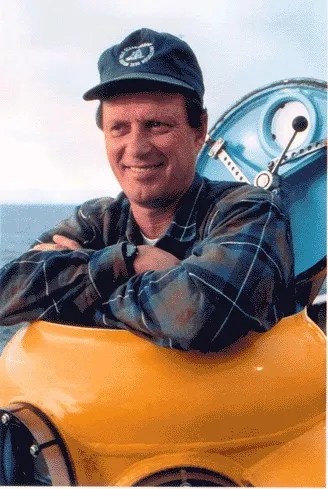
Robert Ballard
He had twelve days left. That was enough.
The oceanographer the world would soon know was Robert Ballard. And the massive boiler that appeared through the darkness in the early hours of September 1, 1985, told him that a search lasting more than seventy years was finally over.
Two lost nuclear submarines had shown him the way. Because sometimes the ocean keeps its lessons in the same places it keeps its secrets. And Bob had learned to read both.
The ship was Titanic.
And now you know the Story Between the Lines.
Enjoyed this? Subscribe and get future reflections, bourbon notes, and assorted nonsense delivered straight to your inbox.
Copyright © 2026 Doug DeBolt.
