
 I don’t remember exactly where I first saw The Cowboys. It was 1972, so I would have been five or six years old, and I might have seen it in a movie theater or at a drive-in. What I do remember, more than half a century later, is a young boy named Charlie getting trampled to death by cattle while trying to retrieve another boy’s glasses. That scene made an impression on me. A big one.
I have a similar childhood memory of True Grit, when Glen Campbell’s character gets struck in the head with a rock and starts bleeding. Apparently, I was a pretty big Glen Campbell fan at that age, and seeing him injured was upsetting. But watching a boy not much older than I was get killed while trying to help a friend was something else entirely.
Those were the images that stayed with me. Not the magnificent scenery, the excitement of the cattle drive, or even John Wayne himself. I remembered a child dying. I recently watched The Cowboys again, and while Charlie’s death remains tragic, it wasn’t what affected me most this time. More than fifty years later, I found myself watching a very different movie. And I think it’s one of John Wayne’s best.
Released in 1972 and directed by Mark Rydell, The Cowboys tells the story of Wil Andersen (Wayne), an aging Montana rancher preparing to drive his cattle hundreds of miles to market. When his regular cowhands abandon him to chase gold, Andersen finds himself without the men he needs to complete the drive. His solution is to hire a group of schoolboys, most of whom have little experience handling cattle and even less understanding of the dangers awaiting them.
It’s a promising premise, but it could easily have become a lightweight comedy about a grumpy old cowboy trying to manage a bunch of mischievous kids. Instead, it becomes a surprisingly moving story about growing up, accepting responsibility, and the difference a good father can make in a child’s life.
Wayne is particularly good here, and that’s worth emphasizing. For all his enormous success, there were times when John Wayne seemed content to play John Wayne. The familiar swagger, gruff delivery, and larger-than-life presence were often enough to carry a picture. But Andersen requires something more, and Wayne delivers it.
In some respects, I think this performance is every bit as good as his Oscar-winning turn in True Grit. Rooster Cogburn was a colorful character, full of eccentricities and bluster. Wil Andersen is more restrained. His emotions emerge gradually, often through small gestures or subtle changes in his attitude toward the boys.
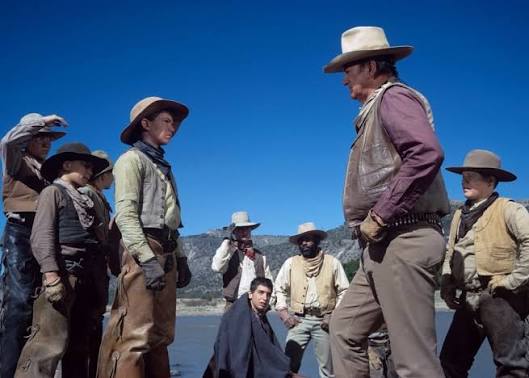 Andersen initially regards his young cowhands as an unfortunate necessity. He needs workers, and these are the only ones available. He’s tough on them, sometimes brutally so, putting them through something resembling military boot camp. But there’s a purpose behind his demands. He knows the dangers of the trail, and he understands that an unprepared boy can quickly become a dead one.
As the journey progresses, however, Andersen begins to change. These aren’t merely hired hands anymore. He becomes their teacher, their protector, their disciplinarian, and eventually something much closer to a father. And the relationship works in both directions.
Andersen’s experience and toughness help the boys become more capable and responsible. But their innocence, vulnerability, and growing affection for him gradually soften some of his rough edges. He learns to be a better father, and they learn to be better sons. Neither transformation feels forced. That’s a tribute to Wayne, Rydell, and an exceptionally well-cast group of young actors.
Robert Carradine, making his feature-film debut as Slim Honeycutt, and A Martinez, playing Cimarron, are particular standouts. But the entire ensemble deserves credit. Each boy has a recognizable personality, and the filmmakers allow those personalities to develop naturally. By the end, it’s easy to forget we’re watching child actors performing a story. They feel like young cowboys who have genuinely grown through their experiences. Yet even after everything they’ve accomplished, they’re still children. That’s an important distinction, and one the movie never completely abandons.
Of course, Andersen isn’t the only adult responsible for their development. In fact, one of the film’s greatest strengths is a character who might easily have been relegated to the background. Roscoe Lee Browne plays Jebediah Nightlinger, the cattle drive’s cook, and he is absolutely magnificent.
Nightlinger is intelligent, articulate, dignified, occasionally mischievous, and possessed of a wonderful sense of humor. If Andersen becomes the boys’ father, Nightlinger is something like a favorite uncle, providing a different kind of guidance and wisdom.
The boys are initially curious about Nightlinger because he’s Black, and some of their questions reflect the racial assumptions of the world in which they’ve been raised. Nightlinger handles their curiosity with a combination of wit and self-assurance, never allowing himself to become diminished by it.
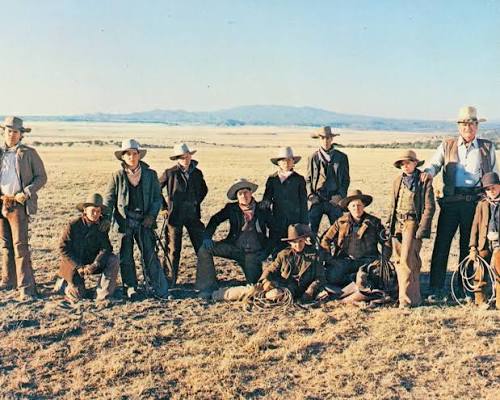 As the journey continues, the boys learn to respect him for who he is. His character, competence, and loyalty matter far more to them than his skin color. That stands in sharp contrast to the film’s villain, Asa Watts, better known as Long Hair, played by Bruce Dern. Long Hair’s racial insults toward Nightlinger reveal another dimension of an already thoroughly despicable character.
Browne gets some of the best dialogue in the movie, and two scenes in particular demonstrate just how important Nightlinger is. The first comes when he faces the prospect of being hanged by Long Hair and his gang. Nightlinger begins what sounds like a sincere prayer of repentance, confessing various sins, including his indiscretions with married women, cheating at cards, and occasional drunkenness. It’s almost comical in its formality, especially under the circumstances.
Then he asks forgiveness for the men he’s killed in anger — and those he’s about to kill. It’s a brilliant moment. A prayer becomes a warning without Nightlinger ever raising his voice or surrendering his dignity. Browne’s timing and delivery are impeccable.
The second scene is considerably more tender, and discussing it requires revealing a major development in the story.
Spoilers ahead. If you haven’t seen The Cowboys, I’d strongly recommend watching it before continuing.
Bruce Dern’s Long Hair is one of the most hateful villains Wayne ever faced. He’s cruel, calculating, racist, and utterly without honor. Dern plays him so convincingly that it’s almost impossible to feel anything but contempt for the man.
 There’s a famous story that Wayne warned Dern audiences would hate him for what his character was about to do. Dern later recalled Wayne predicting exactly that, and the reaction was apparently intense. Some viewers seemed unable to separate the actor from the character, taking their anger over Wayne’s onscreen death out on Dern himself. That’s unfortunate, because Dern was simply doing his job exceptionally well.
Andersen’s death is among the most extraordinary scenes in Wayne’s career. Long Hair repeatedly shoots him, including in the back, while Andersen continues walking away rather than engaging in a confrontation that could endanger the boys.
It’s a remarkable choice for a John Wayne character. The traditional Wayne hero might be expected to turn around, draw his gun, and dispatch the villain. But Andersen understands that there are circumstances in which courage requires something other than fighting. The boys are watching, and he’s still protecting them. He dies acting as their father.
And what follows is heartbreaking. Nightlinger helps the boys bury Andersen on the prairie. Standing beside the grave, he offers words that are among the most beautiful in the film. He reminds them that Andersen belonged to the prairie, which had cared for him throughout his life and would now care for him in death.
It’s a magnificent piece of writing, made even more powerful by Browne’s delivery. The same man who earlier turned a prayer into a threat now uses his extraordinary command of language to comfort grieving children. Andersen taught them how to live and work. Nightlinger is helping them understand how to face death.
 And he isn’t finished guiding them. The boys are determined to recover the stolen cattle and finish the drive. Their motivation isn’t simply violence for the sake of violence, nor are they killing to prove they’ve become men. They’ve just watched the man who became their father get murdered, and they’re determined to honor him by completing what he started.
Nightlinger recognizes the dangers, but he also understands the boys’ determination. He helps them develop a plan, and together they defeat the rustlers. Long Hair meets an especially brutal end, dragged by a horse and drowned. It’s a disturbing death, but after everything we’ve seen him do, it’s difficult to muster much sympathy for him.
The violence in The Cowboys is considerably more convincing than what audiences frequently encountered in Wayne’s earlier Westerns. In some of those pictures, the blood seemed almost neon red, and gunfights had a theatrical quality. Rydell takes a different approach. The injuries, the deaths, and the consequences feel much closer to reality. That sense of realism permeates the entire picture.
It’s worth noting that The Cowboys wasn’t a production of Wayne’s Batjac company. Rydell developed the project independently, and Warner Bros. released it. Wayne was working with a director who wasn’t part of his usual stable, and I think the difference served the material exceptionally well.
Rydell wasn’t making a stereotypical John Wayne Western. He was telling a story that happened to feature John Wayne, and Wayne seems to have embraced that distinction. His performance suggests an actor willing to trust his director and explore emotional territory that some of his more familiar roles didn’t require. The result is a movie that feels as though it really could have happened.
The technical accomplishments are equally impressive. Robert Surtees’ cinematography captures the beauty and vastness of the American West without allowing the scenery to overwhelm the characters. The screenplay, adapted from William Dale Jennings’ novel by Jennings, Irving Ravetch, and Harriet Frank Jr., gives the story a clear beginning, middle, and end, with a few genuine surprises along the way.
And then there’s the music. I’d actually forgotten that John Williams composed the score, which makes me appreciate it even more. This was several years before Jaws, Star Wars, and Raiders of the Lost Ark made Williams one of the most recognizable names in film music, but his considerable gifts were already evident.
What impressed me during this viewing was how perfectly the music captures the film’s different moods. There are playful passages that suit the boys and their adventures, darker moments that acknowledge the dangers they’re facing, and the soaring strings and powerful horns associated with the great Western scores. Williams understands that this is simultaneously an adventure, a coming-of-age story, and a tragedy. His music supports all three without overwhelming any of them.
 Everything comes together in the closing scenes. The boys succeed in bringing the cattle to market, with Nightlinger fulfilling Andersen’s wish that they return safely home. They’ve accomplished something remarkable, but the film’s emotional resolution isn’t simply their success or their victory over the rustlers.
It’s what they choose to do with their first earnings. They buy Andersen a proper headstone, one that acknowledges the place he occupied in their lives. It’s a simple gesture, but it says more about what they’ve learned than all the gunfights and cattle drives combined.
Andersen spent the journey teaching them responsibility, loyalty, courage, and respect. He became a father to boys who weren’t his own, and they came to love him as sons. Now they honor him as their father, and that’s what makes The Cowboys so much more than a conventional Western.
It’s a story about a group of children who become better young men because someone believes in them, challenges them, and loves them enough to demand their best. But it’s also about an aging man who becomes better because those children give him an opportunity to be something more than a rancher.
Andersen becomes a better father. The boys become better sons. And Nightlinger? Well, Nightlinger is Nightlinger. Perhaps he grows, too, but I suspect we simply come to appreciate more fully the extraordinary man he already was.
The Cowboys is better than I remembered, and I now consider it one of John Wayne’s finest films. It’s certainly essential viewing for Wayne fans, and I’d recommend it just as enthusiastically to anyone who enjoys a good Western.
But you don’t have to be a fan of either to appreciate it. The performances, direction, screenplay, cinematography, and music are all first-rate. The plot is distinctive, the characters are memorable, and the story takes us from beginning to end with an emotional honesty that stays with us.
When I was a little boy, I remembered Charlie getting trampled by cattle. More than fifty years later, I find myself remembering something entirely different: a group of boys using the first money they’d ever earned to honor the man who had taught them how to become men.
And I think that’s a pretty good indication of just how much this movie has to offer.
Enjoyed this? Subscribe and get future reflections, bourbon notes, and assorted nonsense delivered straight to your inbox.
Copyright © 2026 Doug DeBolt

That’s a fascinating read. I was force fed Westerns in my childhood by my Dad and I haven’t watched them since because of that 🤣🤣. Your in depth reflection won’t necessarily have me searching out the genre but it’s nice to read your piece as you can see what my Dad used to.