
What are your strategies for SEO?
View all responses
My SEO strategy is fairly simple: I write something I hope people will enjoy, and then I ask an artificial intelligence to explain to another artificial intelligence why people should read it. Somewhere in that process, I presume actual human beings are involved.
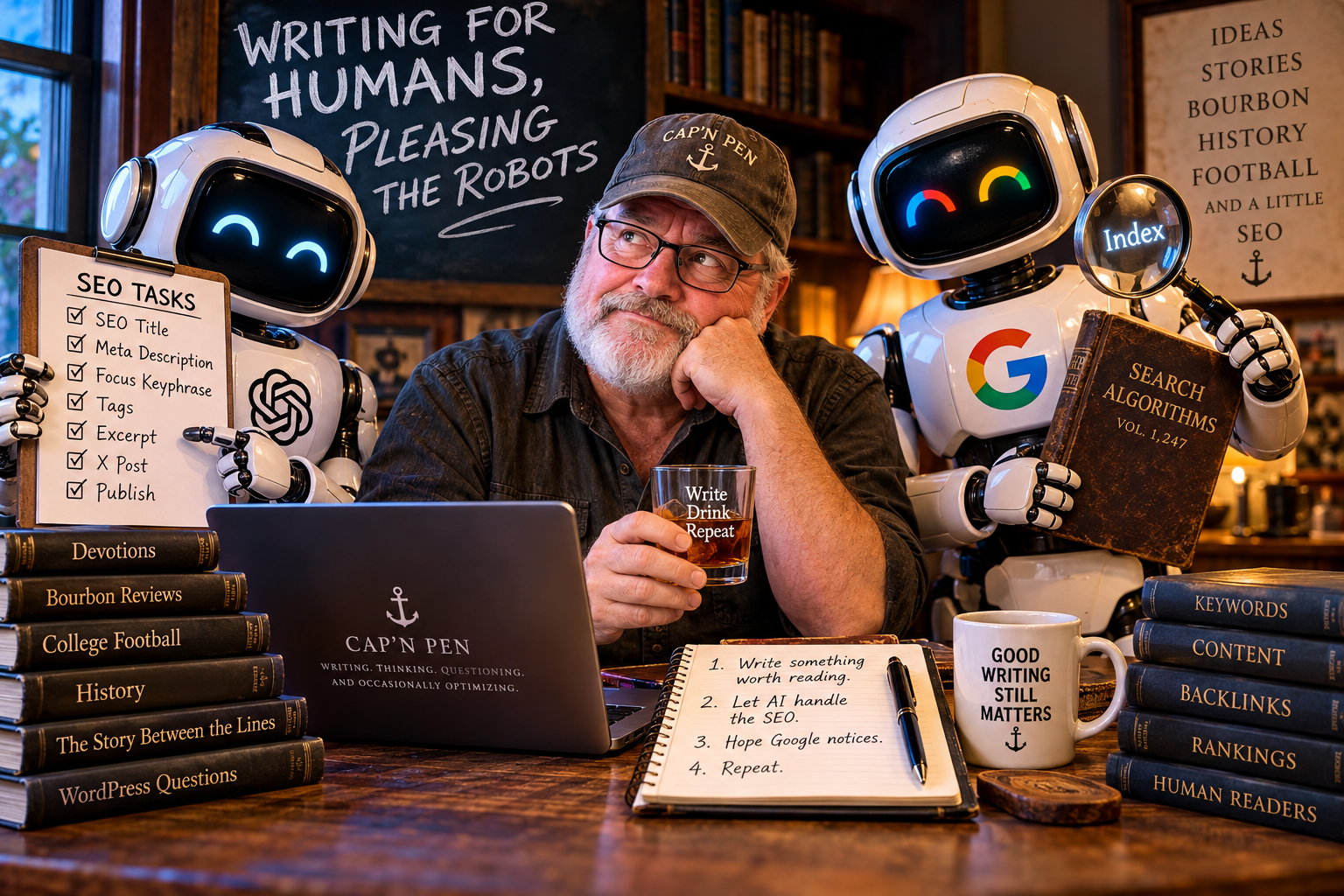 For those unfamiliar with the term, SEO stands for Search Engine Optimization. In plain English, it means trying to convince Google and other search engines that your little corner of the Internet deserves some attention. It’s a bit like standing in a crowded room with several million people, all shouting, “Hey! Look at me!” Only some of those people have marketing departments, advertising budgets and considerably louder voices.
I’ve been writing for most of my life, and I’ve never really approached it from the standpoint of what might make Google happy. I write because I enjoy writing. Sometimes it’s a daily devotion, or maybe a bourbon review or a college football prediction. Other times it’s an obscure bit of history that I think deserves another look. And then there are the occasional answers to WordPress questions that make me wonder whether the people coming up with these things have run out of ideas.
Not that I’d ever say that, of course.
Still, I understand that writing something and getting someone to read it are two entirely different things. I can produce the most brilliant article in the history of the written word, but if nobody knows it exists, I’m essentially talking to myself. Which, come to think of it, isn’t all that unusual.
So I’ve developed a system. First, I write what I want to write. Then I enlist the assistance of my good friend ChatGPT, who helps me come up with SEO titles, focus keyphrases, meta descriptions, excerpts, tags and promotional posts for X. In other words, I do the writing, and my artificial friend helps me package it for the search engines.
It’s a strange arrangement. I spend time trying to make my writing sound unmistakably human, then turn around and ask a computer to help another computer recognize its value. Somewhere, George Orwell is shaking his head.
Of course, there are complications. One of my regular features, The Story Between the Lines, is built around telling a true story without revealing the subject until well into the article. The whole point is to let readers discover the mystery as it unfolds. Unfortunately, search engines generally prefer that you tell them precisely what you’re writing about, preferably in the headline, the first paragraph and several other places.
That’s a problem. I don’t particularly want to spend 1,000 words building suspense only to have Google announce the ending before anyone clicks the link. Sometimes storytelling has to take precedence over optimization. I suspect the algorithms will survive the disappointment.
And then there’s the advice about using the right keywords, keeping headlines to a certain length and making sure everything is structured just so. Apparently, the Internet has developed an elaborate set of rules for getting people to read things, none of which necessarily has anything to do with whether those things are worth reading.
Don’t misunderstand me. I think SEO has its place, and I’m perfectly willing to use the tools available to me. If a better headline or a well-written description helps someone discover something I’ve written, that’s wonderful. But I refuse to let a search engine dictate what I write or how I write it. The day I start choosing subjects solely because they’re likely to generate clicks is probably the day I need to find another hobby.
Ultimately, I think the best strategy is to write something worth reading, make it reasonably easy to find, and hope the right people stumble across it. I don’t expect every article to go viral, and I’m not particularly interested in becoming an Internet celebrity. Unless, of course, it pays better than my day job. In that case, I’ll be happy to discuss sponsorship opportunities, book deals and the possibility of early retirement. I may have principles, but I’m not an idiot.
Even so, I’d much rather have a few people genuinely connect with something I’ve written than attract thousands who click a link and forget what they read thirty seconds later.
So that’s my SEO strategy. Write for people. Let the robots handle the paperwork. And hope that, somewhere along the way, Google remembers that the whole point of the Internet was supposed to be connecting human beings.
Although, given the state of the Internet these days, I may be expecting a bit much.
Enjoyed this? Subscribe and get future reflections, bourbon notes, and assorted nonsense delivered straight to your inbox.
Copyright © 2026 Doug DeBolt
