
I own a device called a Singtrix. It was designed for karaoke, but it can do a lot more than make a mediocre singer sound slightly less mediocre.
With the push of a button, it can turn your voice into Darth Vader, an alien, or something that sounds like an angel choir. It also includes settings that change a male voice into a female voice and a female voice into a male voice, with a couple of variations for each.
One day, I selected the second male-to-female setting and softened my voice just a little.
I sounded like my mother.
Not vaguely like her. Not enough that I had to talk myself into hearing it. The resemblance was immediate, and honestly, a little spooky.
Daryl never knew Mom as her mother-in-law, since Mom died before Daryl and I married, but she did know her. When I used that setting for Daryl, she heard the similarity too.
That experience comes to mind when I think about a piece of technology I am convinced will exist in 20 years.
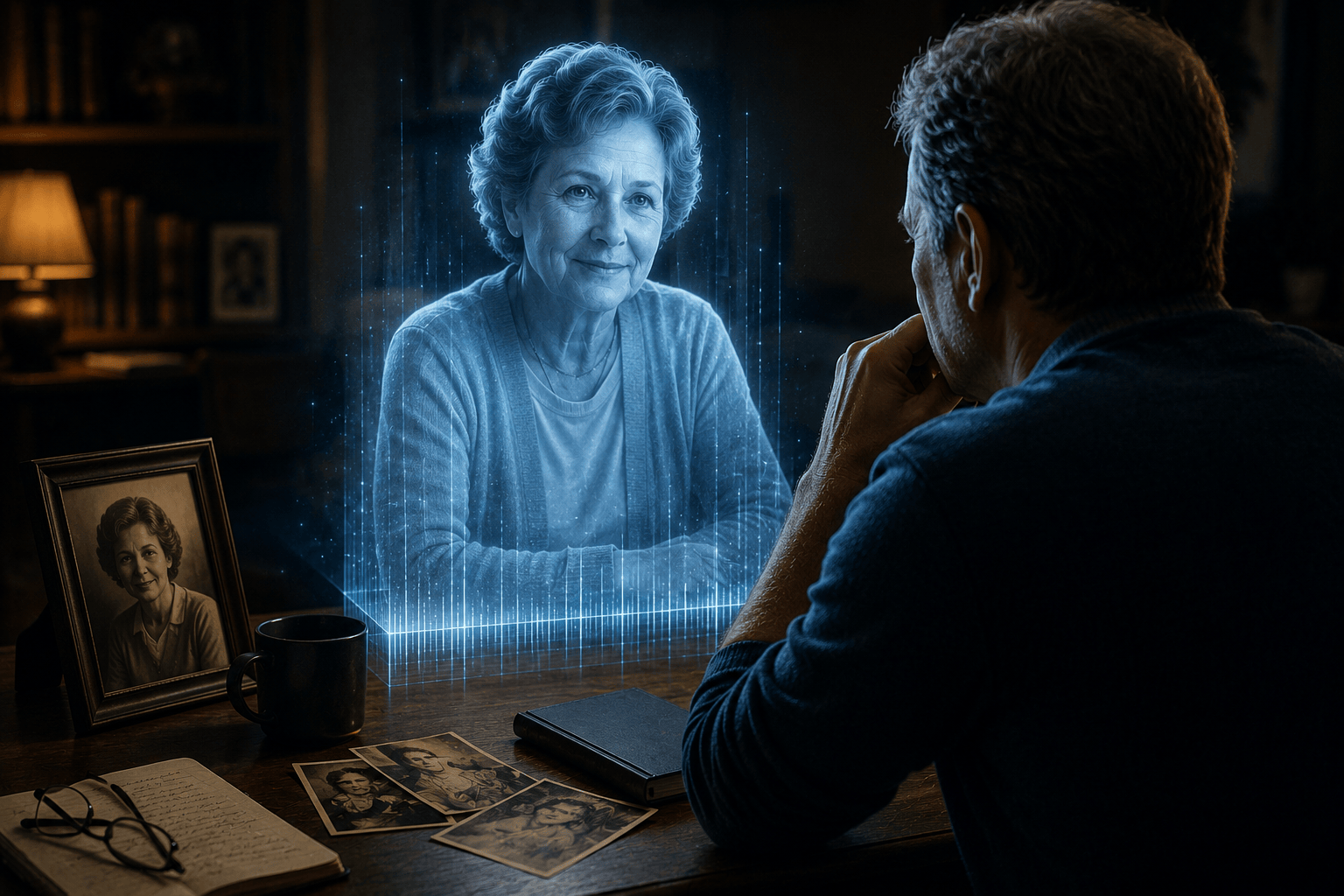 I believe we will have systems capable of preserving enough of a person’s voice, speech patterns, memories, writing, photographs, videos, and personality that family members will be able to have something resembling a conversation with someone who has died.
In early forms, that technology already exists. Artificial intelligence can imitate voices, generate video, study a person’s writing, and respond in ways that sound increasingly natural. Twenty years from now, those abilities will probably be far more convincing than they are today.
A person might create a private archive while still living, recording stories, answering questions, describing important moments, and preserving the sound of his or her voice. After death, children or grandchildren could sit down with that archive and ask about family history, childhood memories, marriage, faith, work, regrets, or any of the other things we often wait too long to ask.
Part of me finds that idea beautiful.
My mother died in 2007. My stepfather died in 2022. My dad died in 2024. Their voices still live inside my head, though not always as clearly as I would like. I remember certain expressions, tones, laughs, and pieces of conversations. Sometimes I can almost hear exactly how one of them would respond to something happening now.
If technology gave me a chance to “talk” to my mother again, I would like to think I would approach it with great wisdom and emotional restraint.
Honestly, I would probably jump at the chance.
I would want to tell her about Lizzi, Daryl, and Sully. I would want her to know that the piano lessons and the books and the lessons about gratitude all stayed with me. I would ask questions that never occurred to me while she was alive, and I would probably ask some that had occurred to me but that I foolishly assumed I would always have time to ask later.
That is what makes the technology both appealing and dangerous.
My Singtrix does not know anything about my mother. It is simply changing the pitch and quality of my own voice. Yet the resemblance is strong enough to stir something emotional in me. If such a simple device can do that, imagine a future system trained on actual recordings of her voice, along with letters, photographs, stories, and whatever else remained behind.
It would not have to recreate her perfectly. It would only have to come close enough for my heart to fill in the rest.
That is the part that concerns me.
There is a healthy difference between remembering someone and pretending that person is still available to us. Old recordings can be comforting. Photographs preserve moments. Stories allow children and grandchildren to know something about people they never met. I would be grateful for anything that helped keep those memories from fading.
A conversation is different.
Once the machine begins answering back, the temptation would be to treat its responses as though they carried the wisdom, love, approval, or judgment of the person who died. But the machine would not be remembering. It would be predicting. It would take what it knew about my mother and calculate what she might have said.
That could sound remarkably real without being real at all.
This subject felt especially close last week when I traveled to Fort Pierce for the funeral of Janis Brown, the mother of one of my best friends, Jay. Funerals remind us how much of a person cannot be packed into an obituary or captured in a collection of photographs.
When a mother dies, an entire storehouse of memories goes with her. Some stories are never told again. Recipes become approximations. Details that once seemed unimportant suddenly matter, and family members discover that no one is completely sure how something happened or what year it was.
Technology may eventually help preserve more of that. I hope it does. A child born years from now might hear Janis laugh, listen to one of her stories, or learn something about her that otherwise would have disappeared. That would be a gift to a family.
Still, as a Christian, I would need to remember that my hope is not in technology’s ability to simulate the dead. My hope is in resurrection. A machine might reproduce my mother’s voice and imitate the rhythm of her speech, but it would not contain her soul. It could remind me of her, perhaps with astonishing accuracy, but it could not bring her back.
I am convinced this technology will exist in 20 years, and I suspect many people will welcome it eagerly. I may be one of them.
The real question will not be whether we can build it. The question will be whether we can enjoy the comfort it offers without asking it to become something it can never be.
Memory is precious, and technology may help us hold on to it longer.
We just need to remember the difference between hearing a familiar voice and being in the presence of the person we loved.
Enjoyed this? Subscribe and get future reflections, bourbon notes, and assorted nonsense delivered straight to your inbox.
Copyright © 2026 Doug DeBolt.
