
Read
They are to do good, to be rich in good works, to be generous and ready to share…
1 Timothy 6:18
Reflect
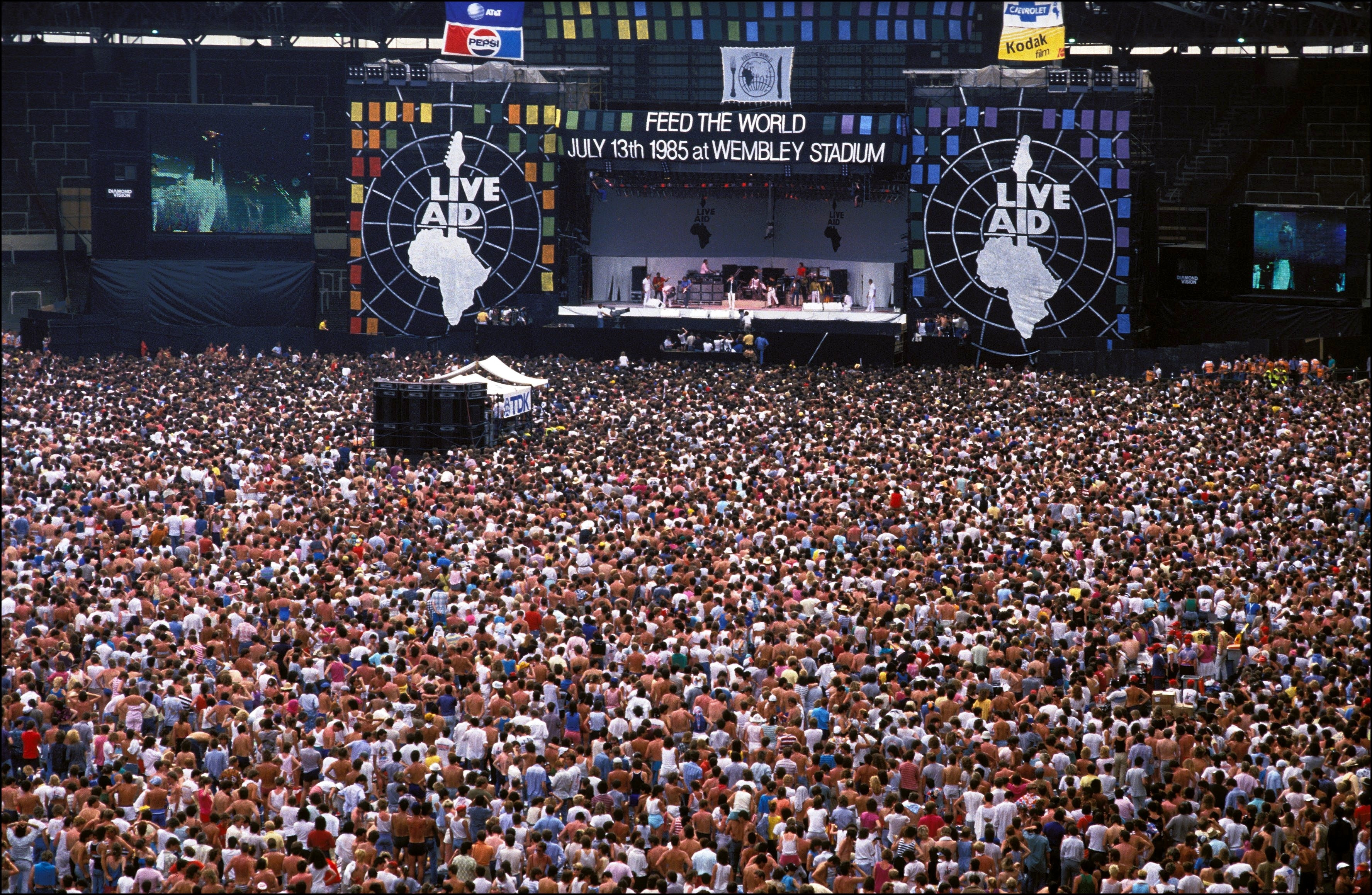
It was like nothing I had ever seen — that anyone had ever seen. More than 50 of music’s greatest artists united in a concert that lasted an entire day and spanned two continents. More than 160,000 lucky concertgoers paid only $35 to see the event in either Philadelphia or London, and millions more tuned in on TV to watch what is still regarded by many as the greatest concert of all time.
It was Live Aid, an event dreamed up by Bob Geldof, the front man of The Boomtown Rats, a band unknown to most in the United States but one that had some success in England. Geldof had previously helped organize Band Aid, a collection of British performers who recorded the single “Do They Know It’s Christmas?” to raise money for and awareness of the famine in Ethiopia. The single brought in millions for famine relief, but Geldof envisioned more. So he used his connections to pull together Live Aid, set for July 13, 1985.
I remember being transfixed as one band after another took the stage at either JFK Stadium in Philadelphia or Wembley Stadium in London. Phil Collins even played both, going on stage in London in the morning and then crossing the Atlantic to play in Philadelphia that night. It was almost impossible to look away. It felt historic while it was happening.
The event eventually helped raise well over $100 million in the hopes of feeding the hungry in Ethiopia. It was a laudable effort, and it unquestionably awakened millions of people to suffering they might otherwise have ignored. But decades later, many people remember the concert more vividly than the crisis that inspired it. If you have watched TV after 11 p.m., you have undoubtedly seen countless commercials asking for help feeding hungry children in far-off countries. Live Aid was an amazing event assembled for a great cause, so why didn’t it make a more lasting difference?
The answer is difficult, and it should be sobering for the Church.
If you look back to the origins of the early Church, you will see that it thrived in part because it met the needs of the less fortunate. According to Professor Rodney Stark of Baylor, the Church experienced exponential growth, especially between 250 and 350 AD, largely because of the godly behavior of its people and because those people cared for people other than themselves. Stark projected what Christian growth could have looked like if the Church grew at roughly 40 percent per decade.
| Christian Growth Projected at Forty Percent per Decade | ||
| Year | Number of Christians | Percent of Population |
| 40 | 1,000 | 0.0017 |
| 50 | 1,400 | 0.0023 |
| 100 | 7,530 | 0.0126 |
| 150 | 40,490 | 0.07 |
| 200 | 217,795 | 0.36 |
| 250 | 1,171,356 | 1.9 |
| 300 | 6,299,832 | 10.5 |
| 350 | 33,882,008 | 56.5 |
The point is not merely that the Church preached. It did preach, and it preached Christ crucified and risen. But the Church also lived in a way that made the Gospel visible. Christians cared for the sick. They helped the poor. They protected abandoned children. They gave dignity to people the world had little use for. They did not merely tell the world about the love of God. They demonstrated it.
I say this as someone who loves the Church and has spent most of my life inside it. I’m a preacher’s kid. I’ve worked for churches. I’ve served on a vestry. I’ve seen churches do beautiful, generous, sacrificial things for people in need. But I’ve also seen churches pour far more energy into buildings, comfort, music, preferences and internal concerns than into the poor. I once belonged to a church that seemed to have more urgency about building a baby cry room than reaching youth, children or the needy outside its own walls. And while a cry room may have its place, the poor were not an optional side mission given to us by the Lord.
While the early Church made an enormous difference in its time, I fear the modern Church often makes a much smaller difference than it should. Today, much of the most visible work among the poor is carried out by government agencies and large private organizations. They may provide food, money, housing, medicine and education, and we should be grateful for every hungry person fed and every suffering person helped. But when the Church steps back from that work, something important is lost. The world can meet a need, but the Church is called to meet needs in the name of Jesus.
That matters because people are not only looking for food, shelter and medicine, though they desperately need those things. They are also looking for mercy. They are looking for dignity. They are looking for someone to see them as more than a case number, a problem, a statistic or a cause. When Christians serve the poor in the spirit of Christ, we do more than hand out help. We bear witness to the heart of God.
The world may not love God, but it does crave goodness, and you can see unchurched, non-Christian people reaching out to help others almost every day. Some may be searching for meaning. Some may simply be responding to human suffering with genuine compassion. Either way, their concern should remind Christians that mercy was never meant to be optional for us. If people who do not claim the name of Christ can be moved by suffering, how much more should those of us who follow Jesus be moved to action?
At the same time, we see Christians striving to build the Church through tracts, revivals and street preaching. There is a place for proclamation. The Gospel must be spoken. But the greatest evangelism has often been tied to meeting the needs of people who need us. Look at the difference Jesus made through feeding thousands, healing the sick and raising the dead. Yes, those were miracles, but they also met the needs of hungry and desperate people. Jesus did not treat physical suffering as a distraction from His mission. He treated it as a place where the mercy and power of God could be revealed.
That is where Live Aid still speaks. It was a beautiful spark, but the Church is called to be a steady flame. One concert can raise awareness. One offering can help. One emotional moment can stir compassion. But lasting difference usually comes through sustained, embodied, repeated mercy — the kind Paul describes when he tells Timothy that God’s people “are to do good, to be rich in good works, to be generous and ready to share.”
More than another Live Aid, we need ongoing efforts like Servolution, which encourages people to change lives through simple acts of kindness. If you are already doing something like this, God bless you and keep up the good work. But if you are looking for a way to get involved, find a place where you can serve the needy. Feed someone. Encourage someone. Visit someone. Give to someone. See someone the world has ignored.
Jesus believed in it. The early Church grew because of it. The need is still there. And the mission still belongs to us.
Enjoyed this? Subscribe and get future reflections, bourbon notes, and assorted nonsense delivered straight to your inbox.
Reflection copyright © 2026 Doug DeBolt.
Scripture quotations are from The Holy Bible, English Standard Version® (ESV®), copyright © 2001 by Crossway, a publishing ministry of Good News Publishers. Used by permission. All rights reserved.
