There are certain things that happen in the early life of a child that sometimes seem to herald the future that child will grow into.
And so it is with the child I’d like you to meet: Nick.
 Few people would have noted the moment of Nick’s birth as anything other than another stormy night, filled with hard rain and restless skies. Years later, people would look back at that night and find meaning in it. But in that tiny village on that day, it was just weather, and Nick was just another baby born into a poor family.
He was born in a place far from where his name would one day become famous. His father was a man of faith and words, a man of the church. His mother had no formal education, but she had the kind of mind that notices how things work. She could make useful objects with her hands. She could solve problems without needing a classroom to tell her she was intelligent.
The boy inherited something from both of them. From his father, perhaps, came the sense that unseen things mattered. From his mother came the belief that what was imagined might also be made.
Nick wasn’t like other boys. That sentence is written so often about famous people that it almost means nothing anymore, but in this case, it seems to have been painfully true. Nick’s mind moved quickly, strangely, intensely. He could picture things so clearly that, to him, the picture was almost the thing itself. He saw possibilities before they existed in wood, metal, wire or machinery.
That kind of mind can be a gift. But it can also be a burden, because when you see something before anyone else does, you have to live for a while in a world that thinks you are wrong.
As a young man, Nick studied, wandered, worked and struggled. There were failures. There were illnesses. There were moments when his future seemed to be slipping away before it had properly begun. But he kept moving, pulled by an idea he couldn’t put down.
 That idea needed a larger stage than the one he had been given, so he eventually crossed an ocean to seek the American dream. He didn’t have much money. He had uncertain prospects. And he had even less idea of how he would turn the seemingly impossible things in his head into something the world could use.
America has always liked that kind of story, at least after it works. The immigrant arrives with almost nothing. The city is enormous. The language is not fully his. The opportunities are real, but so are the traps. He finds work with one of the most famous men in the country, a man already associated with progress, invention and modern life.
For a while, it looked like Nick had found the perfect place.
He had not.
Nick did, indeed, find a famous man who was practical, forceful and commercially brilliant. This man knew how to turn invention into business. He knew how to build systems, protect his interests and make the public see him as the face of the future.
Nick was different. It wasn’t that he lacked interest in money. But money was never the center of his vision. He wanted the idea itself to work. He wanted the world to change because the idea in his mind was true.
Despite their common genius, the difference in their visions meant the two men were not built to stay together. So Nick left to seek an opportunity to complete his vision on his own terms. That was one of the first fractures in the story. Nick had reached the edge of greatness, stood near a giant, and then stepped away from him. Or perhaps he was pushed away. History often depends on which man is telling it.
But leaving the giant did not mean leaving the dream. It meant chasing it without protection.
For a time, Nick was almost nobody. He dug ditches. He lost control of work that should have made him wealthy. He learned that an idea can be brilliant and still belong to someone else if the papers and money say so.
That may be one of the quiet tragedies of his life. He could see the future, but he was not always good at owning it.
Then came the test every dreamer eventually faces: would anyone else believe what he believed before the rest of the world could see it?
 A different businessman did. His name was George, and he was not merely looking for a clever device. He was looking for a system, something large enough to change cities, factories, homes and the daily rhythm of modern life.
Nick’s invention could do just that. It was not a small improvement. It was not a better handle on an old tool. It was a different way of thinking about how power could move through the world.
That is all we need to say for now. A different way. A better way. A way others said was dangerous, impractical or impossible.
And then the fight began.
It was not simply a fight between machines. Machines don’t fight by themselves. People fight through them. Companies fight through them. Egos fight through them. Fortunes fight through them.
The public was warned. People were told to be afraid of Nick and his invention. Demonstrations were staged. Newspapers took sides. Investors watched. Cities wondered which future they should trust.
One side had fame, familiarity and the confidence of the established order. The other side had a restless immigrant, a bold businessman and an idea that seemed too strange — until it started to work.
That was the pivot point. The strange idea won. Not immediately. Not cleanly. Not without ugliness. But it won.
The world moved toward the future Nick had seen in his head long before most people understood it.
That should have been the happy ending.
It wasn’t.
History has a cruel habit of rewarding the people who build the store more than the people who first imagine what should be sold inside it.
 Nick’s ideas spread. His influence grew. His work became part of everyday life. Yet his own fortunes rose and fell in ways that make the story feel almost unfair. He was celebrated, yes. Admired, yes. But celebration is not the same as security, and admiration does not pay hotel bills.
Still, he was not finished. People who see far ahead rarely stop at one horizon.
After helping push the world into one future, Nick began reaching for another. He dreamed of connection without the old limits. He imagined a world in which distance mattered less, in which messages, energy and possibility could move in ways most people could barely understand.
He did not simply want to build a thing. He wanted to remove barriers. He wanted the faraway to become near. He wanted what was hidden around us to become useful to everyone.
So he found a place to build that dream. There was land. There was a tower. There was a plan so large it sounds less like engineering than prophecy.
But prophecy still needs funding, and that was the problem. The money weakened. The confidence faded. The world moved on to inventions it could understand, finance and sell. The tower remained, but the dream inside it never became what Nick believed it could be.
There is something heartbreaking about an unfinished tower. It points upward, but it does not arrive. It stands like a sentence without its final word, like a hymn cut off before the last note, like a promise the world was not ready to keep.
Maybe that was Nick’s deepest wound. Not that he had no ideas. Not that he had failed to see the future. But that he saw so much of it and still could not make the world come with him.
In the final years, Nick became stranger in the public imagination. That happens sometimes when a person’s mind has spent too long living beyond the neighborhood of ordinary conversation. Some called him brilliant. Some called him eccentric. Some probably called him worse.
He loved certain routines. He had peculiar habits. He made grand claims. He lived more and more alone. And then, one day, in a hotel room in New York City, the man who had spent his life imagining the future came to the end of his own.
 He was 86.
By then, much of what he had helped make possible was already woven into the world so thoroughly that people no longer stopped to wonder where it came from. That may be the strangest kind of fame: to change life so completely that your work becomes invisible.
We do not thank the air when we breathe it. We do not thank the road every time we arrive. And we do not always remember the people who made the modern world feel normal.
But there was a boy born during a storm. He grew into a young man who crossed an ocean. And that young man eventually became an inventor who stood beside giants, then walked away from them.
There was a dreamer who saw a future others mocked until they began living inside it.
You know Nick’s invention, even if you may not have known his story. As you read this, your device is powered by electricity flowing through a system he helped revolutionize almost 150 years ago. Every time you flip a light switch, turn on a television or plug in a charger, you are benefiting from the kind of future he saw before much of the world was ready to believe him.
His system was alternating current.
His name was Nikola Tesla.
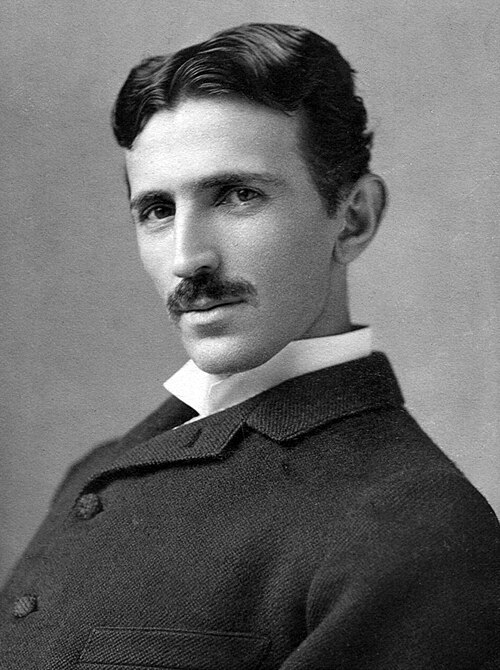 Nikola Tesla was born 170 years ago during a thunderstorm, and in time, people would notice how fitting that seemed. But the real wonder is not the weather outside the room where he was born. The real wonder is that he spent his life trying to show the world the power it could not yet see.
He helped give the modern world its light. He imagined connections that sounded impossible before they became ordinary. And today, every Tesla car that passes on the road carries the name of a man who did not design it, did not found the company that built it, but helped imagine the kind of future that made it possible.
Tesla died in poverty in 1943, and he largely considered himself a failure. But you live in the world he changed, and you know the truth of his success. Because now you’ve read the story between the lines.
Enjoyed this? Subscribe and get future reflections, bourbon notes, and assorted nonsense delivered straight to your inbox.
Reflection copyright © 2026 Doug DeBolt.
