


The biggest benefit of minimalist living is that it gives people with empty countertops a socially acceptable way to judge the rest of us.
I understand the appeal. I really do. There is something freeing about getting rid of things you don’t use, don’t need, don’t remember buying, and couldn’t identify in a police lineup.
I have a garage full of that stuff.
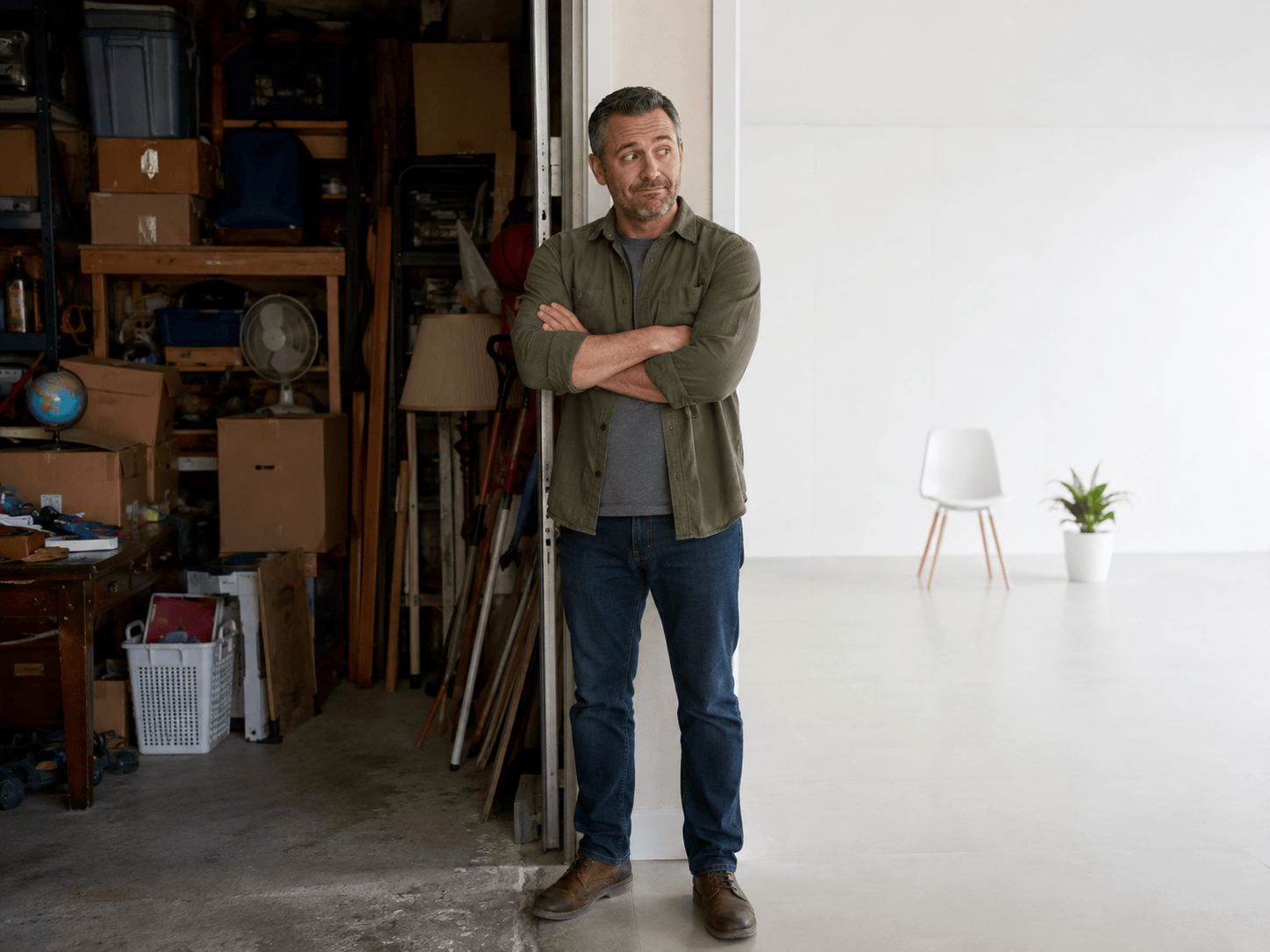 Some of it is probably useful. Some of it was useful in 2009. Some of it is waiting for a project I have emotionally committed to but will almost certainly never actually complete. There are items in my garage that have been moved from one side to the other so many times they probably think they’re in witness protection.
My classroom isn’t much better. I have things on shelves I didn’t touch this year. I have supplies I saved because “I might need them someday,” which is teacher-language for “this will sit here until I retire or move classrooms under duress.”
And then there’s the filing cabinet.
I inherited a filing cabinet from teachers who have since retired, and possibly from teachers who retired before they retired. It contains hand-me-down lesson plans, old worksheets, mystery folders, and papers that look important enough not to throw away but not important enough to ever open. They sit there collecting dust like educational artifacts from a lost civilization.
So yes, I get decluttering.
I get the value of simplifying. I get the idea that less stuff can mean less stress. I understand that if your home, classroom, closet, garage, or desk looks like a storage unit had a nervous breakdown, your life probably does not feel more peaceful because of it.
There is a real benefit to clearing out what no longer serves a purpose. There is freedom in letting go of things that only take up space. There is wisdom in not buying more things just because they are on sale, because “on sale” is how half of America ended up with a bread maker, a fondue pot, and seventeen charging cables for devices that no longer exist.
But full-on minimalism?
That’s where I start backing away slowly.
The people who go all-in on minimalist living strike me as belonging to the same general category as full-on preppers and full-on vegans. I’m not saying they’re wrong. I’m saying they have turned a reasonable personal choice into a lifestyle badge.
There’s a difference between “I should probably get rid of some clutter” and “I own four possessions and one of them is a stool.”
That kind of minimalism always seems to come with a tone. It’s not enough to have fewer things. You have to experience a spiritual awakening because you donated your third saucepan. You have to explain that your life changed once you stopped being chained to material objects, which is usually said while standing in a beautifully lit room containing one chair, one plant, and a bowl nobody is allowed to touch.
And I’m sorry, but I don’t trust a living room without evidence.
A home should have some evidence that people live there. Books. Photos. Dog toys. A blanket someone actually uses. A drawer with batteries, tape, keys that fit nothing, and a tiny screwdriver from a pair of reading glasses. A shelf with things that matter for reasons no one else would understand. Maybe even a few bottles of bourbon waiting patiently for their moment.
That is not clutter. That is civilization.
The real problem isn’t owning things. The problem is being owned by things. The problem is when stuff becomes burden instead of blessing, when it takes up space physically, mentally, emotionally, and possibly in the garage where the Christmas decorations are blocked by a box labeled “miscellaneous” that has not been opened since the Obama administration.
So I’m not anti-minimalism. I’m anti-minimalist evangelism.
Simplifying as a matter of self-improvement makes sense. Decluttering because your surroundings are making you feel crowded makes sense. Getting rid of things you never use, don’t care about, and only keep because throwing them away requires making a decision makes sense.
But I have no desire to turn emptiness into a personality.
I don’t want to live in a house that looks like a Scandinavian hotel room where no one has ever eaten a sandwich. I don’t want my shelves cleared of everything except one tasteful vase and a book placed sideways for visual balance. I don’t want to own exactly seven shirts and pretend laundry day is now a spiritual discipline.
I want less junk, not less life.
That’s probably the biggest benefit of minimalist living, at least for normal people who aren’t trying to win the Monastic Olympics. It reminds us to be more intentional. It pushes us to ask whether we’re keeping things because they matter or because we just haven’t gotten around to dealing with them.
And in my case, the answer is often very clear.
I haven’t gotten around to dealing with them.
But maybe that’s the place to start. Not with a dramatic vow to own only what fits in a backpack. Not with a social media announcement about my new journey toward simplicity. Not with throwing away everything that doesn’t spark joy, because some things don’t spark joy but still turn out to be the exact cord you need six months later.
Maybe the benefit is simply this: minimalist living, in moderation, can help us stop confusing accumulation with security.
It can help us make room. Room to think. Room to breathe. Room to work. Room to park a car in the garage, which I understand is something some people still do.
I’m not there yet.
But I can see the appeal.
I may never be a minimalist, but I could probably stand to be a little less maximalist. And somewhere between “garage full of forgotten stuff” and “one chair and a moral superiority complex,” there has to be a healthier place to live.
Enjoyed this? Subscribe and get future reflections, bourbon notes, and assorted nonsense delivered straight to your inbox.
Share this:
- Print (Opens in new window) Print
- Email a link to a friend (Opens in new window) Email
- Share on Facebook (Opens in new window) Facebook
- Share on WhatsApp (Opens in new window) WhatsApp
- Share on X (Opens in new window) X
- Share on Pinterest (Opens in new window) Pinterest
- Share on Telegram (Opens in new window) Telegram
- Share on LinkedIn (Opens in new window) LinkedIn
- Share on Tumblr (Opens in new window) Tumblr
- Share on Reddit (Opens in new window) Reddit
