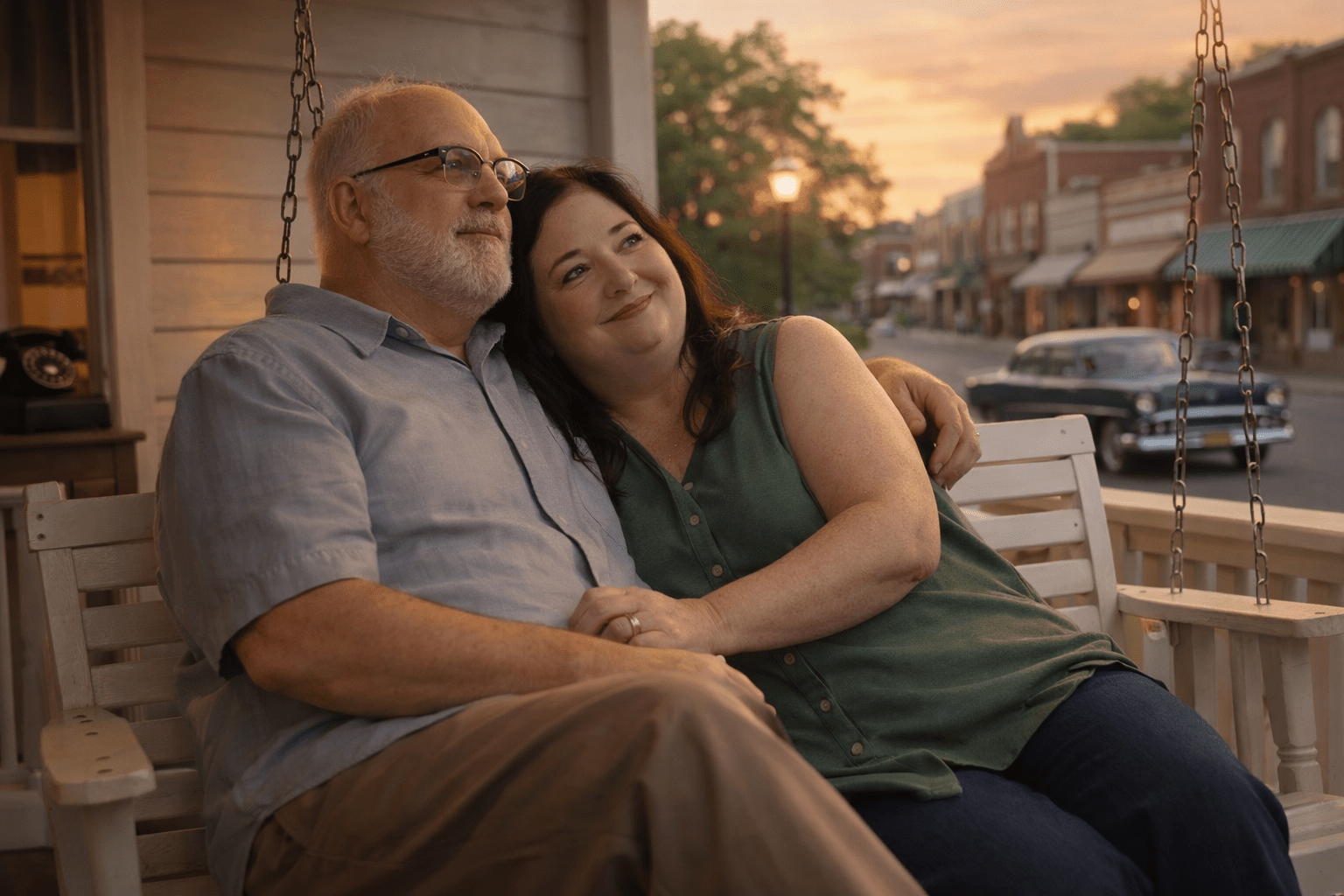
Love Is the Only Thing I Can’t Live Without

Daily writing prompt
What are three objects you couldn’t live without?

It’s an interesting question because it assumes there are objects that are indispensable. That there are things so essential to my daily rhythm that without them, life would somehow stop.

But the older I get, the less I believe that.

My cellphone is an incredible convenience. It keeps me connected to Daryl, to Lizzi, to Sully. It lets me write, post, photograph a pour, text a friend, check on a student, call a game. But if it disappeared tomorrow, I’d adjust. I’d go back to landlines and handwritten notes and knocking on doors if I had to.

My car? Wonderful. Necessary in Jacksonville, it feels like. But I could ride a bus. I could carpool. I could walk more than I do now.

My laptops—both personal and work—are tools I use every single day. They help me teach, write, research, publish. But if they were gone, I’d go back to pen and paper. I’d draft longhand. I’d find a way.

History is full of people who lived deeply meaningful lives without any of those things.

But love? That’s different.

Without God’s love anchoring me, I’m untethered. Without my family’s love, the victories feel hollow. Without the simple, tail-wagging, unconditional affection of Princess greeting me at the door, the house feels quieter than it should.

Love isn’t a convenience. It’s oxygen.

Saying that reminds me of someone far wiser than I am. In 1 Corinthians 13:1–3, the apostle Paul wrote:

“If I speak in the tongues of men and of angels, but have not love, I am a noisy gong or a clanging cymbal… If I have all faith, so as to remove mountains, but have not love, I am nothing.”

All the gifts. All the knowledge. All the sacrifice.

Nothing without love.

When it comes down to it, objects are tools. Useful. Sometimes wonderful. Sometimes sentimental. But tools all the same. Love is the only thing that makes the tools matter.

And if I’m honest, it’s the only thing I truly can’t live without.

Copyright © 2026 Doug DeBolt.

Posted in Daily Prompt, Random | Tagged , , , , , , , , , , , | Leave a comment

Quick Thought – Tuesday, March 3, 2026: Not a Matter of When

Read

Matthew 20:1-16

Don’t I have the right to do what I want with my own money? Or are you envious because I am generous?’
Matthew 20:15

Reflect

Crash test collisionImagine this scenario. Bob and Tim both live their lives pretty much the way they want to for a lot of years. But one day, Bob decides that following God is a pretty good idea, and he gives his life to Christ. Meanwhile, Tim keeps doing his own thing.

The years go by, and Bob has become a devoted Christian. He serves in the church, shares his faith and is an all-around good guy. Tim, however, has gone the other direction. In doing his own thing, he has had a string of bad relationships, is an alcoholic and has been thrown in jail several times. It is there that Tim finally understands the Gospel, and turns his life over to Jesus.

That night, Tim is released from jail, and on the way home, he and Bob have a head-on collision, killing both of them instantly.

The question is this: Which one will the Lord let into heaven? And the bigger question is this: Assuming He lets both of them in, which one gets the greater share of heavenly rewards?

That’s what today’s passage is all about. Jesus tells the story of workers hired to do a job for a specific wage. Later in the day, other workers are hired, and they’re paid the same wage. The first workers are angry, feeling they should have been paid more, but the master’s point is, “Why should you care what I paid someone else as long as you got the pay you deserved?”

His point is that it doesn’t matter when you show up to the family of God, as long as you show up. God doesn’t love anyone less just because they took longer to accept Him. If you accepted Christ when you were 99 years old, the Lord has the same love for you as the child who accepted him when they were four. (Of course, it’s a big chance to wait until you’re 99, but that’s another story…)

Today, pray that the Lord will give you His heart for all believers, regardless of when and where they came to faith.

Reflection copyright © 2026 Doug DeBolt.

Scripture quotations are from The Holy Bible, English Standard Version® (ESV®), copyright © 2001 by Crossway, a publishing ministry of Good News Publishers. Used by permission. All rights reserved.

Posted in Faith | Tagged , , , , , , , , | Leave a comment

The Teachers I Didn’t Ask For

Daily writing prompt
What experiences in life helped you grow the most?

If I’m honest, the experiences that helped me grow the most weren’t the victories.

We love to point to our successes as proof of progress. Promotions. Awards. Milestones. Anniversaries. Those moments feel like growth because they’re visible. They’re measurable. They come with applause.

But the truth is, the moments that shaped me most didn’t come with applause.

They came with silence.

Losing a job early in my career hurt more than I let on at the time. I remember the sting of it — the embarrassment, the self-doubt, the quiet fear about what came next. But that loss forced me to look in the mirror. It made me ask hard questions. Was I working as hard as I could? Was I coasting? Was I bringing enough value to the table? I decided then that if I was going to be somewhere, I was going to matter there. I was going to make myself invaluable. That lesson stuck.

Losing my parents — including my stepfather — changed me in a different way. Grief has a way of rearranging your priorities. When you realize you can’t call someone anymore, can’t ask one more question, can’t hear their voice again, you start paying closer attention to the people who are still here. I learned that relationships aren’t automatic. They require intention. They require staying in touch, even when life gets busy. They require forgiveness. I don’t always get that right, but I value it more deeply because I’ve felt the absence.

Divorce was another painful classroom. No one walks into marriage expecting it to end. When it does, you’re left sorting through pieces — what you did well, what you didn’t, what you should have seen, what you should have said. It forced me to confront my own shortcomings. It forced me to understand what makes a marriage strong: communication, humility, daily investment, shared faith, shared purpose. Those weren’t just concepts after that. They became commitments.

Even moving to Jacksonville later in life — leaving behind familiarity and stepping into something new — stretched me. Starting over at 48 isn’t something you script in your twenties. But growth rarely comes from comfort. It comes from stepping into the unknown and trusting that God is writing something bigger than the chapter you’re currently in.

Pain is a good teacher. I just wish the tuition wasn’t so high.

If I could choose, I’d rather grow through joy. Through celebration. Through ease. But the reality is that some of the deepest roots only form when the ground has been broken up. Failure humbles us. Loss refocuses us. Heartbreak refines us.

I wouldn’t volunteer to relive those hard seasons. But I wouldn’t erase them either.

They made me who I am.

Copyright © 2026 Doug DeBolt.

Posted in Daily Prompt, Random | Tagged , , , , , , , , , | Leave a comment

Quick Thought – Monday, March 2, 2026: The Pain of Deception

Read

Genesis 27

Now Esau hated Jacob because of the blessing with which his father had blessed him, and Esau said to himself, “The days of mourning for my father are approaching; then I will kill my brother Jacob.
Genesis 27:17


Reflect

Cheating in SchoolDeception always comes at a high price. Any action you make can earn you some consequences you didn’t plan on – good or bad. Your positive actions might generate infinitely more good attitudes than you counted on. At the same time, your negative actions can have far-reaching consequences beyond what you can see at the moment.

Let me share an incident from my history. When I was in high school, I was part of a gifted English program. Because we were in an advanced program, we were expected to perform at a high level in pretty much every area. One of those areas was vocabulary, where making a perfect score on the tests seemed impossible to us. We studied and struggled for a couple of months, and yet could never seem to overcome the difficulty of the exams.

That’s when a student from the previous year’s class told us how they ended up passing the tests – they’d started stealing the answers. It turns out that every class for many years had done this and passed that secret on to the next year’s edition. With that knowledge in hand, my buddy Clark and I led the way in getting the answers and passing them to our fellow classmates. There were only about 15 of us in the class, and we had 100 percent participation.

Each week, we’d decide who would get less than 100 percent – to make sure not everyone would immediately pop up to perfection. The plan went perfectly for months until one day, one of us decided to steal the answers in the middle of class and got caught red-handed – me. That day, I earned a three-day out-of-school suspension, which also meant that all work that I missed while at home counted as a zero. Our final term paper and presentation were due during my suspension, but I was allowed to turn them in early (though the grades on both were terrible). My grade in the class went from an A to barely a C. Rightfully, I should have failed the course.

Even though one of my classmates “outed” everyone else for cheating, without proof, they escaped punishment. Still, our teacher, who had been so close to us that year, was hurt that we would show such disrespect to her. While I was cheating on those tests, it seemed so innocent – just a better grade on a test. I didn’t see how it might threaten my graduation and rupture a relationship between a teacher and her students – or between my parents and me. It took some time before I was able to regain their trust.

Jacob’s deception of Isaac and Esau was far worse. A father’s blessing was highly prized and could contain details about the son’s inheritance and the future. When Jacob stole Esau’s blessing, he received promises of the richness of the earth, as well as control over his family – including Esau. Rebekah knew that would be the case and chose Jacob over Esau to receive the blessing. Jacob went along with the plan, and in so doing ensured that his brother would thereafter seek to kill him.

That’s the way it always is when we’re caught in deception. It doesn’t matter if we intended to hurt someone or not – the fact that you deceived someone will break that relationship, and sometimes that break can be permanent. The only way to avoid that is to not deceive and to always be honest. Honesty has its own rewards (such as “Blessings accrue on a good and honest life, but the mouth of the wicked is a dark cave of abuse.” and Honesty lives confident and carefree, but Shifty is sure to be exposed” – Proverbs 10:6 and 9 – The Message).

Always prize honesty over deception. Regardless of the seeming innocence of the act and the ease of the supposed rewards, the price of deception will always be higher than you can measure. And the true rewards of honesty will always exceed what you can see at the moment.

Reflection copyright © 2026 Doug DeBolt.

Scripture quotations are from The Holy Bible, English Standard Version® (ESV®), copyright © 2001 by Crossway, a publishing ministry of Good News Publishers. Used by permission. All rights reserved.

Posted in Faith | Tagged , , , , , , , , , , , , , , , | Leave a comment

The Sunday Pour: The Shared Toast

Raising a glass together binds us. It’s less about the drink than the unity in the clink.

There is something almost instinctive about it. Two hands lift. Two eyes meet. Two glasses tilt toward each other and—clink—a small, bright sound rings out.

It would feel strange not to do it. To simply sip on a wedding day. To quietly drink at a birthday. To swallow at a funeral without that shared moment of acknowledgment. Without the clink, it feels like drinking. With it, it becomes a toast.

The origins of that small collision go deeper than we often realize.

Some historians suggest the practice began as a gesture of trust. In earlier centuries, when poison was a legitimate fear at feasts and negotiations, hosts and guests would strike their cups together hard enough for liquid to slosh from one vessel into another. If one drink was tainted, both would share the consequence. It was a primitive but powerful declaration: I trust you with my life.

Others point to spiritual roots. In certain ancient cultures, drinks were offered to the gods or the departed before being consumed by the living. The raised cup acknowledged something beyond the table—an unseen presence, a blessing, a remembrance. The sound itself was thought by some to ward off evil spirits, the sharp ring chasing away darkness.

There’s also a sensory explanation I’ve always liked. A toast engages nearly every sense.

We see the amber or the sparkle. We smell the aroma rising from the glass. We feel the weight of it in our hand. We taste what’s inside.

But the clink? That adds sound. It completes the experience. All five senses gathered into a single shared act.

That might be why it feels incomplete without it.

In my own life, the clink has framed more memories than I can count. Weddings where champagne shimmered and hope was loud and obvious. Birthdays where the years behind us felt both heavy and sweet. Even funerals—quiet rooms where bourbon or wine caught the light and the toast wasn’t to celebration, but to remembrance.

In those moments, the drink itself fades. I couldn’t tell you what was in every glass I’ve raised. But I can still hear the sound.

That soft, intentional strike says: We are here together. It says: This moment matters. It says: I see you.

You and I both know that drinking can happen anytime. A pour on an ordinary Tuesday doesn’t require ceremony. But when we lift the glass in unison, when we wait for the others at the table, when we lean in and make that gentle connection—suddenly it’s no longer about what’s in the glass.

It’s about who’s around it.

The shared toast binds us, not because of the alcohol, but because of the acknowledgment. The unity in the clink turns a beverage into a memory. And long after the bottle is gone, long after the labels fade and the flavors blur together, that small bright sound lingers.

We might forget what we drank.

But we won’t forget raising the glass.

Copyright © 2026 Doug DeBolt.

Posted in Bourbon, Faith | Tagged , , , , , , , , , | Leave a comment

Not Fate, Not Destiny — But a Plan

Daily writing prompt
Do you believe in fate/destiny?

Honestly, the idea of fate has always felt a little too mechanical to me. Like life is a railroad track already laid down, and we’re just passengers staring out the window, convincing ourselves we’re driving.

As a Christian, that doesn’t quite line up with what I believe. Fate suggests a script that’s been written in ink — every choice predetermined, every misstep scheduled, every heartbreak inevitable. That kind of worldview makes us actors reciting lines instead of people living lives.

But I do believe in something deeper than randomness.

I believe in a God who knows the end from the beginning — not because He forced it into existence, but because He stands outside of time. I believe in a Father who wants the very best for His children. I believe He has a plan — not a rigid script, but a direction. A calling. A design.

And here’s where it gets complicated. Because He also gives us freedom.

Real freedom. The kind that lets us love Him or ignore Him. The kind that lets us make wise choices or foolish ones. The kind that allows us to hurt people — or heal them. That freedom means our stories are not puppeteered. They are lived.

Looking back on my own life, I can see moments that felt almost orchestrated — Jacksonville, Daryl, the classroom, friendships that intersected at just the right time. But I can also see decisions I made that veered off course. Times I chose poorly. Times I delayed obedience. Times I created messes that I then had to walk through.

If fate were real, none of that would matter. It would all just be “meant to be.” But grace only makes sense if choice is real.

So no, I don’t believe in destiny in the sense that everything is locked in and inevitable. I don’t believe we’re marching toward a fixed ending no matter what we do.

But I absolutely believe in a plan.

I believe God lays out a path toward goodness, purpose, and wholeness. I believe He invites us into it. I believe He nudges, convicts, redirects, and sometimes closes doors we’re stubbornly trying to force open.

And when we wander? He doesn’t throw away the story. He weaves redemption into it.

Maybe that’s the better word — not fate, not destiny, but redemption.

We are not stuck on rails. We’re walking a road. And the Father walks with us. The direction is there. The invitation is constant.

The choice is ours.

Copyright © 2026 Doug DeBolt.

Posted in Uncategorized | Tagged , , , , , , , , , | Leave a comment

Quick Thought – Sunday, March 1, 2026: What Do You Value More Than Jesus? (Second Sunday in Lent)

Read

Matthew 19:16-30

And Jesus said to his disciples, “Truly, I say to you, only with difficulty will a rich person enter the kingdom of heaven. Again I tell you, it is easier for a camel to go through the eye of a needle than for a rich person to enter the kingdom of God.”
Matthew 19:23-24

Reflect

Camel standing in a sunsetOften when you read this blog, I’ll tell a story that attempts to illustrate a biblical principle. Other times, Jesus tells the story so well that it’s foolish for me to even try.

In this case, the story is set up by a rich young man who wants to know what it will take for him to achieve eternal life. The young man had the religion part down pretty well – he clearly knew his scriptures and the “legal” requirements of the Jewish law. But Jesus added a caveat that threw the young man for a loop – sell all of your possessions, give the money to the poor and follow me

That, of course, revealed the true love of the young man’s life – money. He wanted to be able to follow Jesus and keep all of his wealth. And honestly, Jesus wouldn’t have been against that – if the young man was merely willing to give everything up. But our Lord was able to discern the young man’s heart, and He knew that money would always take first place. And Jesus already had a disciple who had too great an affection for money.

Jesus doesn’t tell us that rich people can’t be Christians. But He does say it’s incredibly difficult. Even in His time, wealthy people had a love for money that separated them from God. But there were also undoubtedly wealthy people who loved God and put Him first.

I know godly people today that you’d consider wealthy. One is the founder of a family of amusement parks. Another started a successful home-building company. Another was a board member for a major petroleum company. But all of them have used their means to further the Gospel, and I fully believe that they would gladly give it all up if they had to choose between their money and following the Lord.

That isn’t the case for most rich people. Honestly, it isn’t even the case for most poor people. If you have anything that you’d not be willing to give up for Jesus, then you have a material obstacle in your life – an idol – that you love more than the Lord. To follow Jesus to the fullest, we have to be willing to put everything aside for Him.

Today, pray that the Lord will show you if you have anything in your life that you prize more than Him. Ask Him to help you set those things aside in your heart, and also ask Him to guide you in knowing where He would like you to use your means to further His kingdom.

Reflection copyright © 2026 Doug DeBolt.

Scripture quotations are from The Holy Bible, English Standard Version® (ESV®), copyright © 2001 by Crossway, a publishing ministry of Good News Publishers. Used by permission. All rights reserved.

Posted in Faith | Tagged , , , , , , , , , | Leave a comment

The Phase That Slipped Away

Daily writing prompt
Describe a phase in life that was difficult to say goodbye to.

Some phases of life don’t end with a ceremony. They just thin out until one day you realize you’re standing in something different.

When I left Atlanta at 48, I told myself I wasn’t leaving fatherhood behind. I was just changing ZIP codes. Planes fly both directions. Highways run north as easily as they run south. Distance is manageable, I said.

But fatherhood from a distance is not the same thing.

It becomes intentional instead of incidental. You don’t get the ordinary anymore. You don’t overhear life happening in the next room. You don’t get the unplanned conversations in the kitchen or the slammed door followed by, “Dad, can we talk?” You get scheduled time. You get updates. You get moments that feel heavier because they’re measured.

Then she moved in with Talon.

There wasn’t a dramatic announcement. No soundtrack playing in the background. But it marked something. She wasn’t just growing up. She was building her own home, her own daily rhythm. And I wasn’t anywhere near the center of it.

I was proud of her. I still am.

But underneath that pride was a quiet grief for the season when I was the daily dad — the dad who fixed things in real time, who showed up without notice, whose presence was assumed. That version of fatherhood had already begun to fade when I moved. Her stepping fully into adulthood simply made it official.

I don’t regret moving. I don’t regret marrying Daryl. Love brought me here. Conviction brought me here. A new calling brought me here.

But even good decisions can cost something.

The phase I had to say goodbye to wasn’t her childhood. It was proximity. It was the simple privilege of being woven into the everyday fabric of her life.

And yet — here’s the part I didn’t see coming — distance didn’t unravel us.

It forced us to choose each other more deliberately.

Our conversations mean more now. The time we get together carries weight. And when I hear my grandson laugh, I’m reminded that the story didn’t shrink; it expanded. I may not stand in the center of her daily life anymore, but I still stand in the circle.

Gratitude does something strange to grief. It doesn’t erase it. It just steadies it.

Some phases slip away quietly.

But if you’re paying attention, you’ll realize they didn’t disappear. They simply changed shape — and left you with more to be thankful for than you first understood.

Copyright © 2026 Doug DeBolt.

Posted in Uncategorized | Tagged , , , , , , | Leave a comment

Quick Thought – Saturday, February 28, 2026: Feasting on Crow and Pie

Read

Genesis 33

Jacob said, “No, please, if I have found favor in your sight, then accept my present from my hand. For I have seen your face, which is like seeing the face of God, and you have accepted me.”
Genesis 33:10

Reflect

Humble Pie now served!In the middle ages, the chopped-up “innards” of a deer were often cooked into a pie. These were called the “umbles” and the pie was “umble pie.” Very often, this sort of pie was eaten by people from a “humble” station in life, and the term evolved into “humble pie.” Eventually, in English society, that term took on the meaning of owning up to something you had done wrong.

In the early 1800s, there was a story about an American soldier who shot a crow with his rifle. A British officer complimented the young man on the shot and asked to see the rifle, which he then turned on the soldier, demanding that the young man take a bite from the crow. Once the rifle was returned, the soldier turned the tables on the officer, pointed the gun at him and forced the Brit to consume the rest of the crow. That’s one story about how we got the term “eating crow,” or taking up the distasteful task of admitting a serious wrong.

In Genesis 33, you can see Jacob eating a healthy portion of crow and humble pie. After a number of years living far away from home, Jacob has finally decided to return home, but he realizes that means he will come face-to-face with his brother Esau – who he had duped out of his birthright and inheritance. Jacob had every reason to suspect that Esau would still be hacked off about the deception, especially since they hadn’t seen or communicated with each other since then. In Genesis 32 you see Jacob preparing for the impending showdown, which finally takes place in Genesis 33.

Jacob ultimately had to face up to what he had done, and he did so by offering a huge gift of livestock to show his brother that he was truly sorry. And he found that an amazing thing had happened – time and distance had done an incredible healing work on Esau’s heart. Their eventual face-to-face meeting completed that healing as the brothers were finally able to put the past behind them.

Putting off the difficult tasks of life rarely works out well. At some point, you will have to eat crow or humble pie and come face-to-face with whatever you’ve been avoiding. That’s especially true in relationships, where the rawness between two people only gets worse the longer their differences go unresolved.

Today, search your heart and ask the Lord if there are any difficult situations in life that you need to deal with. If there are, ask Him to give you the strength to face those situations with strength and courage, and to stand with you along the way.

Reflection copyright © 2026 Doug DeBolt.

Scripture quotations are from The Holy Bible, English Standard Version® (ESV®), copyright © 2001 by Crossway, a publishing ministry of Good News Publishers. Used by permission. All rights reserved.

Posted in Faith | Tagged , , , , , , , , , , | Leave a comment

Born a Few Decades Too Late?

Daily writing prompt
If you could be someone else for a day, who would you be, and why?

If I could be someone else for a day, I don’t think I would.

I’m not interested in a full-on Freaky Friday swap where I wake up in someone else’s life and they wake up in mine. That feels unsettling. Where would they go? What would they do with my responsibilities? No, thank you.

Sure, I’d love to experience a moment. I’d love to know what it felt like to be Mike Schmidt watching a game-winning home run clear the fence. Or Roger Staubach releasing a perfect spiral with seconds left. Or Tiger Woods hitting a 150-yard shot so purely you know — before it even lands — that it’s headed straight for the cup.

But those are moments.

What I’ve always been curious about isn’t a who.

It’s a when.

If I could step into someone’s shoes for a day or two, I’d want those shoes to belong to someone living in the 1950s. Not a celebrity. Not a historic figure. Just an ordinary person on an ordinary Tuesday.

Daryl and I have both said it before — we sometimes feel like we belonged to a different era. I’ve always wondered if that’s nostalgia talking… or something deeper.


The Simplicity Question

I don’t romanticize everything about the 1950s. It wasn’t perfect. It wasn’t fair for everyone. There were tensions and injustices we can’t ignore.

But I do wonder about the pace.

  • No smartphones.
  • No social media.
  • No 24-hour outrage cycle.
  • News arriving once a day instead of every 45 seconds.
  • Evenings on the porch instead of in front of a glowing screen.

Did life feel slower because it actually was slower? Or because we only remember the good parts?

Would I miss my access to information within the first hour? Would I feel disconnected without the ability to text Lizzi, check a score instantly, or Google whatever random question pops into my head?

Or would I feel lighter?


The Pressure of Now

Today, you’re expected to:

  • Have an opinion instantly.
  • Respond instantly.
  • Be reachable instantly.
  • Know instantly.

The 1950s had pressures too. They just weren’t digital.

I’d want to wake up in a world where the rhythm of the day was shaped more by sunrise and sunset than by notifications. A dinner table where the biggest interruption was the neighbor knocking on the door. An evening that ended because the sun went down — not because the battery did.

But a day wouldn’t be enough. A day would feel like a novelty. A costume. A vacation from reality.

To really know if I belonged there, I’d need a work week. A disappointment. A hard conversation. A long, slow Saturday with nothing planned. Belonging isn’t about aesthetics. It’s about endurance.

Would I still love that era after a month without modern medicine at my fingertips? After a week without the conveniences I take for granted? After realizing that some of what we call “simplicity” was actually limitation?

Maybe I’d come back cured of my longing. Or maybe I’d come back with clarity.


Maybe It’s Not About Going Back

Maybe this question isn’t about stepping into someone else’s shoes at all.

Maybe it’s about asking what parts of that era I can choose now.

  • More porch, less phone.
  • More conversation, fewer notifications.
  • More intentional evenings with Daryl.
  • More presence with my students.
  • More quiet once the school day ends and the room empties.

I don’t need to live in 1955 to slow down. But I might need to imagine 1955 to remember that slowing down is possible.

If I could step into another time for a day or two, I’d go. Not to escape. Not to rewrite history. But to test a suspicion I’ve carried for years — that somewhere between rotary phones and front-porch swings, life breathed a little easier.

And if I’m wrong?

At least I’d come back grateful for the era I’ve been given — and determined to shape it a little more like the one I sometimes wish I’d known.

Copyright © 2026 Doug DeBolt.

Posted in Daily Prompt, Random | Tagged , , , , , , , , , , | 1 Comment