
Two boys grew up learning very different meanings of responsibility.
 One learned it from usefulness. He came from a world where life was practical, plain, and close to the ground. The people around him valued work, discipline, duty, and a kind of stubborn seriousness. There was affection there, but not much room for laziness or self-importance. A person was expected to become useful, and a mind was not an ornament. It was a tool. So he sharpened his.
He read, studied, argued, and pushed. He learned that ideas did not move through the world on their own. Someone had to carry them. Someone had to defend them. Someone had to stand in rooms full of hesitation and say what others were still afraid to say.
He was brilliant, but not graceful. He could be courageous, suspicious, blunt, thin-skinned, deeply principled, and exhausting before breakfast. He did not always know how to make himself easy to like, but he often knew how to make himself impossible to ignore. If he believed something was necessary, he could become a hammer.
The other boy learned responsibility from inheritance. His world had more space in it — more books, more music, more refinement, and more room to imagine. He grew up with advantages the first boy had to climb toward one handhold at a time. Beauty mattered to him. Language mattered. Design mattered. The shape of an idea mattered almost as much as the idea itself.
His mind moved in wide circles. He wanted to understand soil and stars, buildings and books, instruments and governments, the habits of people and the possibilities of mankind. He could be charming without seeming to try. He could make thought sound elegant. He could give music to arguments that sounded harsh in another man’s mouth.
But he, too, was complicated. His ideals were sometimes cleaner than his life. His vision could soar higher than his choices. He could describe the dignity of human beings in words that still glow, while living inside contradictions he never fully resolved. Still, when words were needed, few could match him.
One man was force. The other was form. One could push a door open. The other could make people believe the room beyond it was worth entering.
For a while, they needed each other.
That is often how history works. It rarely uses one kind of person. It gathers the restless and the reflective, the fighters and the builders, the loud and the lyrical. It takes one person who will not stop pushing and another who can explain why the push matters.
Their shared task was dangerous, though not because it looked dangerous from a distance. From a distance, it looked like paper. That is one of history’s better disguises.
 Paper can seem harmless once it has been framed, preserved, quoted, admired, and placed safely behind glass. But before the glass, before the ceremonies, before anyone knows which side will win, paper can be a weapon. Paper can accuse. Paper can divide. Paper can announce that the old arrangement is over and that the people signing their names are no longer asking permission.
That kind of paper requires more than ink. It requires nerve.
The first man had plenty of that. He had been arguing toward the moment long before the room was ready to admit where the argument was leading. He understood momentum. He understood fear. He understood that some men needed to be persuaded, some needed to be cornered, and some simply needed to hear courage spoken aloud before they could find their own.
But he also understood his limits. There are people who can win an argument and people who can make the argument live after the room has emptied. He was the first kind. The other man was the second.
So the writer wrote.
He did not invent every idea. No great public sentence is born out of nothing. He gathered what had been whispered, preached, debated, studied, suffered, and hoped. He drew from philosophy, grievance, memory, ambition, and the deep human ache to stand upright under the sky without asking another man how tall one was allowed to be.
Then he gave it shape.
Others trimmed it. Others altered it. Others pressed their thumbs into the clay. That is what groups do. But something essential remained. The music remained. The moral force remained. The sense that a people was not merely complaining about yesterday, but reaching toward tomorrow.
 For one season, the hammer and the harp struck the same note.
Then tomorrow arrived.
Tomorrow is where many partnerships go to be tested. It is easier to agree that a door must be opened than to agree on what should be built on the other side. Once the great act was done, the two men began to look at the future and see different dangers.
The first man trusted guardrails. He knew too much about human weakness to romanticize freedom without structure. He believed passion could become a mob, and that noble words could be ruined by foolish men if no strong frame held them upright. He wanted stability, order, law, restraint, and a government with enough strength to survive the moods of the moment. He feared that a new thing, no matter how beautiful, could collapse under the weight of its own excitement.
The second man trusted horizons. He feared cages more than crowds. He believed people needed room to rise, room to govern themselves, room to spread, grow, fail, try again, and become something larger than old systems had allowed. He was wary of too much power gathered in too few hands. He saw promise in openness, distance, possibility, and the ordinary citizen’s claim on the future.
One feared what people might do without boundaries. The other feared what rulers might do with them. Neither fear was foolish. Neither vision was complete. And neither man was small enough to stop caring when the other disagreed.
That was the problem. They both cared too deeply.
Their disagreement did not remain private. Big ideas rarely do. Other voices joined in. Supporters sharpened the edges. Opponents assigned motives. The two men became symbols before they had finished being friends.
That is one of public life’s cruelest tricks. It flattens living people into positions.
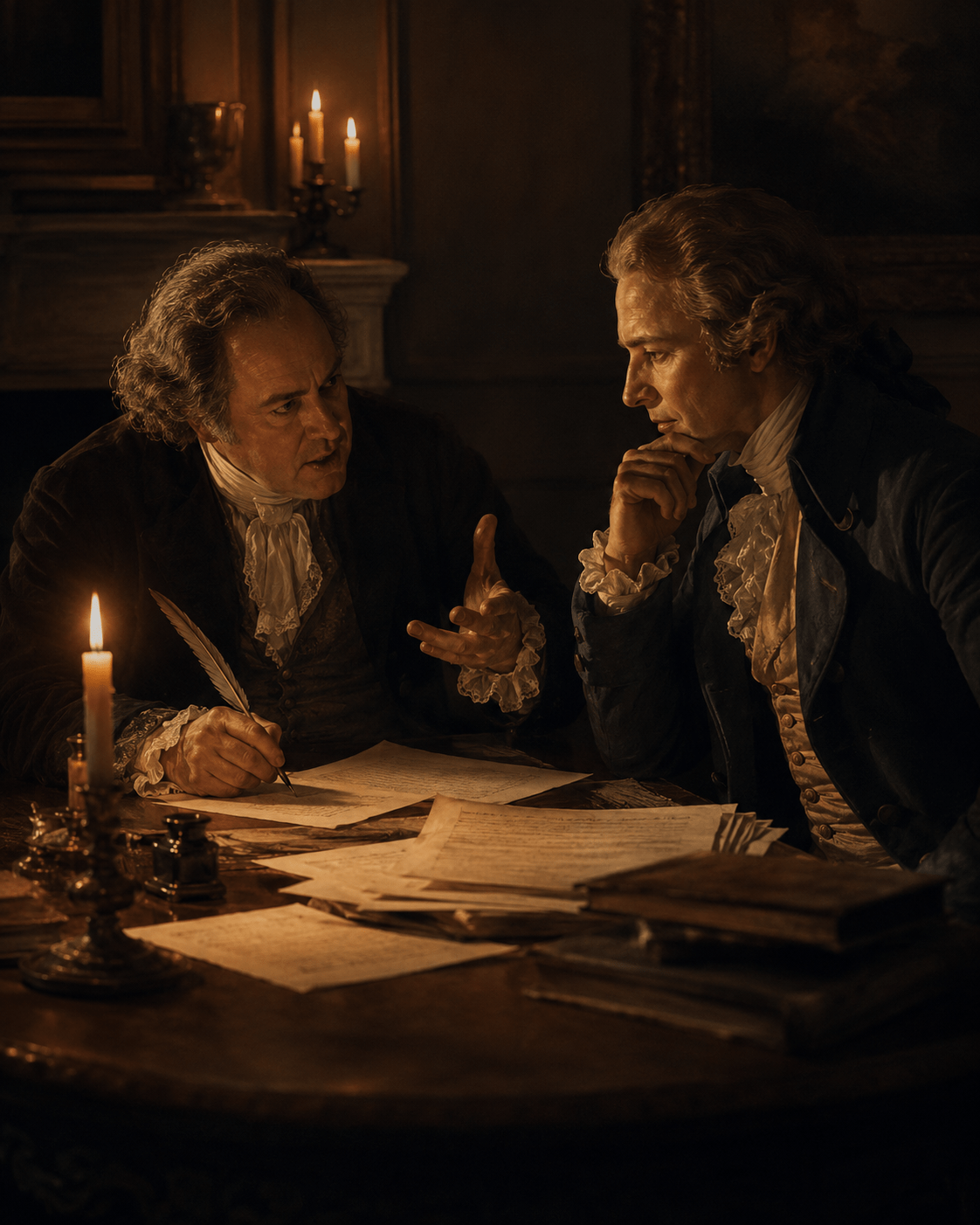 Soon, the old partnership was buried beneath suspicion, rivalry, injury, and pride. What had once been a shared labor became a long argument over what their shared labor meant. Each man believed the other was endangering the thing they had both helped bring into being.
Perhaps that is why the wound cut so deeply. Indifference would have been easier. But they were not indifferent — not to the work, not to the future, and not even, finally, to each other.
Years passed. The shouting moved on to younger lungs. The offices, honors, burdens, and attacks drifted into memory. Both men grew old enough to understand that being right is not the same thing as being whole. They had lost people they loved. They had outlived battles that once seemed permanent. They had watched their great shared experiment become real, flawed, noisy, astonishing, and stubbornly alive.
Eventually, the silence broke. At first, it was a small bridge made of sentences. Then another. Then another.
Two old men, once divided by ambition and conviction, began meeting again on paper. They wrote about ideas, memory, grief, books, age, friendship, and the strange experience of watching the world continue without asking their permission. The sharpness did not disappear completely. It had always belonged to them. But the old affection returned with it.
They had not become the same man. They had become old enough to love across the difference.
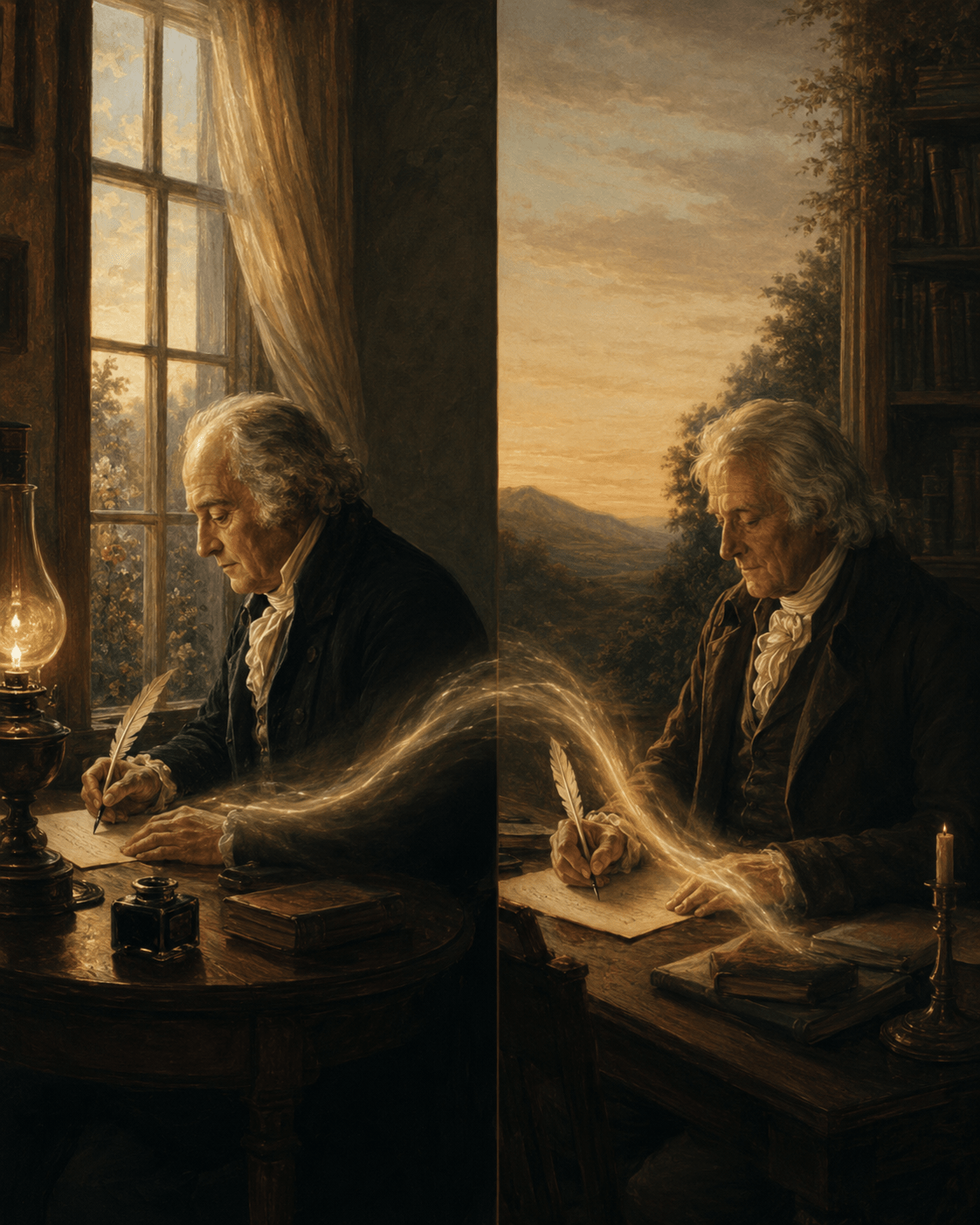 There is grace in that — not the easy grace of pretending the arguments never mattered. They did matter. The differences were real. Their visions had shaped the lives of others. Their words had consequences. Their rivalry left marks.
But age allowed them to see something younger men often miss. A shared love can survive different fears. A common cause can outlive a bitter season. Sometimes the person who wounded you most deeply did so because he was guarding the same treasure from the opposite side.
Near the end, each man was far from the other. Both were frail. Both were famous. Both belonged, by then, more to memory than to daily life. The world had already begun turning them into monuments, though they were still breathing. Their flaws were being softened. Their sentences were being polished. Their arguments were being simplified by people who preferred heroes they could quote without having to understand.
But the men themselves had never been simple. One had been too fiery for marble. The other had been too contradictory for bronze. They were human beings first, with all the glory and wreckage that comes with that.
Then came the day that had followed them for half a century.
The calendar returned to the date of their greatest shared labor. Around them, others celebrated what the two old men had helped set loose. The day had become public property by then — filled with speeches, memory, gratitude, and noise.
For the two of them, it was quieter. It was breath. It was waiting. It was the body surrendering what the mind still held.
 One of them, near the end, reportedly thought of the other and took comfort in the belief that his old friend still remained.
But his old friend had already gone.
The hammer and the harp were silent.
The two boys who had learned responsibility in such different ways had traveled different roads into service, different roads through conflict, and different roads back toward friendship. They had argued because they cared. They had wounded because they feared. They had reconciled because, at last, they remembered that love of country is not always expressed in the same accent.
One helped force the moment. One helped give the moment words. Together, they helped a people say what it meant to become a nation.
The first man was John Adams.
The second was Thomas Jefferson.
They stood together in the cause of American independence. They later became political rivals with very different visions for the country’s future. In old age, they reconciled through a remarkable exchange of letters.
 And on July 4, 1826, fifty years after the adoption of the Declaration of Independence, they died only hours apart.
One reportedly died believing the other still lived.
But the other had already gone.
Different men. Different gifts. Different fears. One country.
Now you have met the two boys who grew into the men who loved their country enough to risk everything for its birth, spend their lives arguing over its future, and carry it in their hearts until their final breaths — only hours apart.
And that is the story between the lines.
Enjoyed this? Subscribe and get future reflections, bourbon notes, and assorted nonsense delivered straight to your inbox.
Copyright © 2026 Doug DeBolt.

This is excellent. Jefferson was more philosophical but that was his theory. As president he moved with power as he needed to. They were not as different as it seemed, they were more different in philosophy and thought but executed very similar when needed with the power of the presidency. The surprise of the group was Hamilton. He was the most brilliant of all. He drove them both nuts and forced Jefferson to walk away.