
The Cracker Barrel near me still has the old sign and hasn’t yet undergone the remodel. It feels like home—at least for now.
I’m not a frequent visitor to Cracker Barrel these days, but there was a time when I went quite often, and I’ve always had a good feeling about it. The food was never about Michelin stars—it was about comfort. The charm was in the rocking chairs on the porch, the checkerboards, the old-timey candy and toys in the store, and the sense that you’d stepped into something familiar. Nostalgia was the product, just as much as biscuits and gravy.
That’s why the recent push to “modernize” the brand feels so off. If Cracker Barrel had leaned into creative marketing to bring people in on the strength of what made it unique—its roots in Americana and nostalgia—I’d be all for it. But instead, they’ve stripped away much of what gave the place its soul. They’re trying to look like every other pancake-and-eggs breakfast chain out there. And I can’t help but wonder: are things so bad that leadership is willing to risk destroying their own identity just to chase a new crowd?
The New Coke Problem
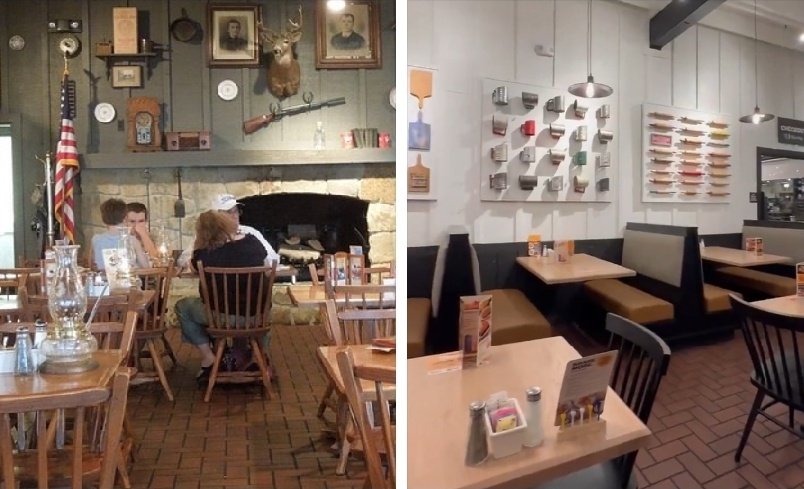
Side by side: the Cracker Barrel we grew up with vs. the new minimalist version. One feels like home. The other feels like everywhere else.
When Coca-Cola launched “New Coke” back in 1985, it was one of the biggest corporate misfires of all time. Customers revolted, and after just a few months, Coke was able to pull the plug and bring back the original formula. It was embarrassing, but ultimately recoverable—Coke simply reversed course and went back to what people loved.
Cracker Barrel doesn’t have that luxury. Once you’ve gutted every restaurant, stripped out the rocking chairs, swapped cozy front porches for sterile open spaces, and filled dining rooms with cold, modern décor, there’s no easy rewind button. Coke could just pour the old formula back into cans. Cracker Barrel has spent hundreds of millions remodeling its spaces, and the cost of undoing it all would be astronomical.
That’s why the CEO’s insistence that “everyone loves the new look” rings so hollow. Customers are telling a different story—loudly. The deeper issue isn’t just aesthetics, it’s trust. If longtime guests feel ignored, if they sense the brand they cherished has been ripped away and replaced with something unrecognizable, no amount of corporate spin is going to bring them back.
Signs of a Deeper Shift—Or Just a Digital Cleanup?
There’s another shift under the surface that’s hard to ignore—not just in aesthetics but in messaging.
Some critics have labeled the update as “Cracker Barrel gone woke.” While I’ve tried to avoid jumping into that framing, there are some telling developments:
-
A board member with a background in DEI strategy—formerly at Disney and leading a DEI consultancy—has been highlighted by critics as indicative of a broader ideological pivot.
-
A link to Cracker Barrel’s DEI page seems to have disappeared. Media outlets confirm the company has rebranded its DEI section to “Culture and Belonging,” signaling a shift in public emphasis.
-
The company has drawn legal scrutiny: America First Legal filed complaints with the EEOC and Tennessee AG, alleging Cracker Barrel’s diversity initiatives could violate employment law.
And then there’s the splashy move into New York City. Cracker Barrel opened a pop-up restaurant in Manhattan—a place with sky-high rent, a different cultural fabric, and a clientele far removed from the moms, pops, and travelers who traditionally fill Cracker Barrel’s rocking chairs. Instead of reinforcing its Southern comfort roots, the company seems intent on impressing a crowd that never built its brand in the first place.
It’s less about broadening their reach than rewriting their story.
A Familiar Pattern: Just Ask Southwest
Cracker Barrel isn’t the only brand making this mistake. Look at Southwest Airlines. For decades, they built loyalty around three simple perks: no baggage fees, open seating, and cheaper tickets. That combination made them unique. Now? They’re charging for bags, charging to pick a seat, and their fares are right in line with the other major carriers.
And just like Cracker Barrel’s CEO, Southwest insists the changes are what customers asked for. But the people I know who’ve flown them (myself included) don’t buy it. The very features that made Southwest stand out are vanishing, and with them goes much of the goodwill. It’s a lesson in how easy it is to trade identity for conformity—and how costly that trade can be in the long run.
What They Could Have Done Instead
Here’s the frustrating part: Cracker Barrel didn’t need to torch its identity to stay relevant.
It already had the tools. They could have leaned into nostalgia marketing—something no other chain does quite as well. Imagine campaigns built around multigenerational traditions: “Bring your grandkids where your grandparents brought you.” Highlight the quirky general-store items, the peg games, the road-trip CDs. Reinforce that Cracker Barrel is the place where travelers feel at home—past, present, and future.
Even small tweaks could have carried big weight:
-
Rotating seasonal menus tied to classic Americana dishes.
-
Spotlighting regional recipes that remind people of their own family tables.
-
Doubling down on the retail store experience with curated “retro finds.”
All of that builds on what Cracker Barrel already owned—comfort, familiarity, memory. Instead, they’ve chosen to erase that foundation in favor of something that makes them indistinguishable from IHOP or Perkins.
Losing What Made Them Special

The gift shop is still full of familiar touches. Nostalgia isn’t a weakness—it’s the strongest card Cracker Barrel ever had.
The irony is that by trying to broaden their appeal, they’re narrowing their identity. You can find trendy, modern breakfast spots anywhere. You could always find Cracker Barrel in one place—Cracker Barrel. Or at least, you used to.
I actually stopped by the Cracker Barrel nearest me yesterday. It hasn’t undergone the overhaul yet—the old logo is still there, the porch still has its rocking chairs, the store still feels like the one I remember. And that’s what makes this whole thing even harder to swallow. It makes me wonder: is there still time for the CEO to pull back, to realize what’s at stake, or is she locked in on a course that will erase what made the brand special in the first place?
And here’s the heart of it: nostalgia isn’t a weakness—it’s the strongest card Cracker Barrel ever had. Strip it away, and you’re just another chain with pancakes and coffee. Keep it, and you’ve got something generations of families already love.
If Cracker Barrel forgets that, they won’t just lose customers—they’ll lose the only thing that ever made them special.
Copyright © 2025 Doug DeBolt.
